PPR pipes and fittings
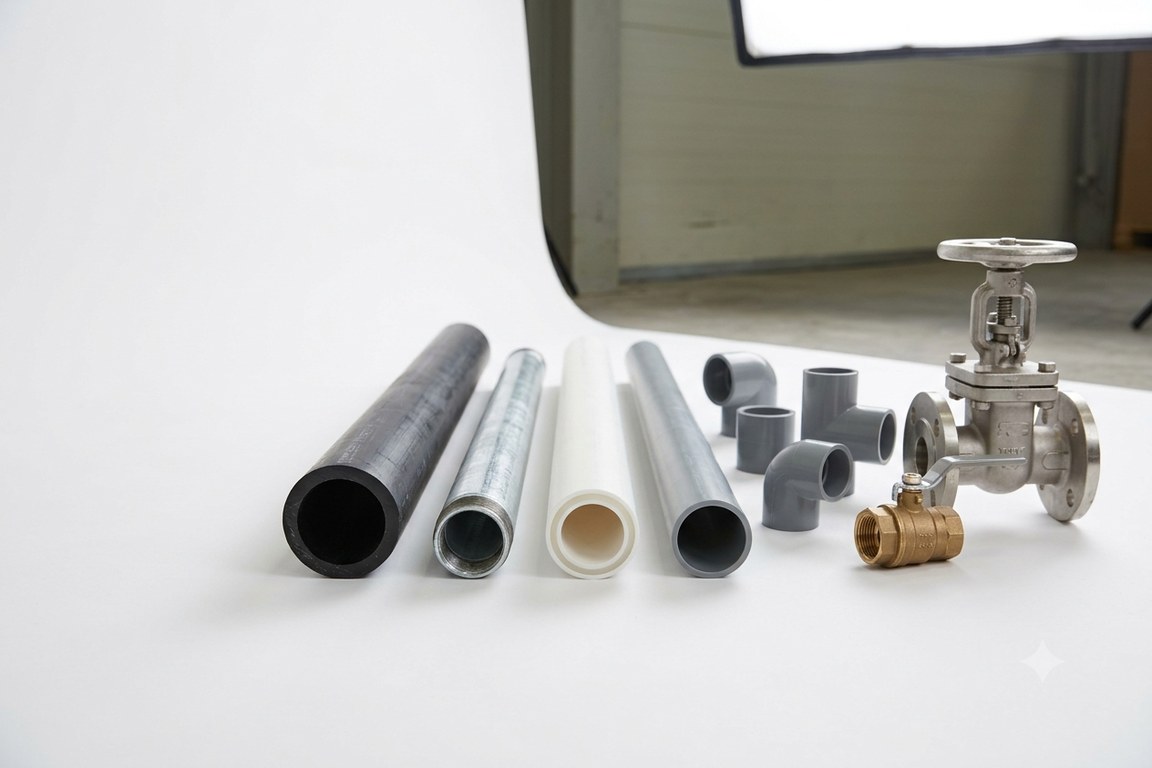
Polypropylene random copolymer systems for hot and cold water inside buildings. Pressure class, dimension series and the fitting range are read together.
Need Saudi certification support for PPR, PVC, HDPE or metal pipes, pipe fittings or industrial valves? BenzilaCert helps manufacturers and importers review material specifications, intended use, Saudi classification, test evidence and relevant conformity procedures.
Send to scope a pipe or valve file:
A category label is not enough to classify these products — the material and the intended service sit behind every one of them.
Polypropylene random copolymer systems for hot and cold water inside buildings. Pressure class, dimension series and the fitting range are read together.
Rigid PVC for drainage, waste and cold water supply. The intended service — pressure or gravity — changes which standard applies.
Polyethylene pipe for buried water, gas and network use, supplied in coils or lengths. The resin grade and the dimension ratio carry the specification.
Welded and seamless steel pipe. Grade, wall thickness, coating and pressure rating define the product rather than the nominal bore alone.
Ball, gate, butterfly and check valves. Pressure class, seat and leakage performance, body material and the service medium define them.
Connection components supplied as independently traded articles, with their own dimensional standards and their own classification.
Part (5) covers network pipes — and names what it excludes.
SASO publishes a Technical Regulation for Building Materials — Part (5): Pipes Used in Water, Electricity and Gas Networks, which brings certain pipes, pipe fittings and accessories within its scope. The same regulation expressly excludes water pipes and accessories used in firefighting systems from that scope.
So neither statement holds across the category: not every pipe follows Part (5), and a firefighting product is not covered by it simply because it carries water. Products outside its scope are screened against whatever other rules do apply — for firefighting items, see fire safety equipment certification.
A valve, a flange and a pipe are not one product
They do not necessarily share an HS code or a conformity route. The exact material, intended use, connection type, diameter, pressure class and project requirement are screened per item before a route is chosen.
Material, function, connection type and whether the item is independently traded.
Four things drive the classification: the material — plastic, steel, brass; the product function — pipe, valve or fitting; the connection type, diameter and pressure class; and whether the item is a complete article traded on its own rather than a component of something else.
No speculative 12-digit Saudi code is published on this page for that reason. It is confirmed per product from what will actually be invoiced — see our HS code check.
Potential review topics by product group, where they apply.
| Product group | Potential review topics (where applicable) |
|---|---|
| PPR, PVC and HDPE pipes | Dimensions, pressure class, material, hydrostatic and other relevant performance |
| Metal pipes | Grade, dimensions, coating and pressure rating |
| Pipe fittings | Connection type, compatibility, material and performance |
| Industrial valves | Pressure rating, seat and leakage performance, materials and service |
| Special-use and fire-system products | Separate applicable standards and a separate regulatory route |
Which specific laboratory tests apply is set by the current standard and the scheme the product falls under. The topics above are what an assessment may draw on — they are not a list of tests mandatory for every pipe, fitting or valve.
What lets a pipe or valve assessment start without a second round of questions.
Send the material, pressure specifications and the size list per group. We will review which items fall inside the applicable regulation and which need their own route.
Which conformity procedure applies is determined for the exact item.
Some covered building-material schemes involve an additional manufacturing assessment alongside the product evidence. Whether Type 1, Type 3, another conformity procedure or any factory review actually applies is determined for the exact item under the regulation in force.
What does not hold is the shortcut: that all PPR, PVC and HDPE products are Type 3, or that every valve brings a video factory audit with it. Where a factory assessment does apply, it needs scheduling early — see factory inspection for Saudi certification.
Five steps, from classification to shipment documentation.
Material, intended service, diameter range and the proposed Saudi HS code are established per product group rather than across the catalogue.
Check whether the item falls inside the applicable technical regulation — including whether it falls inside one of its exclusions.
Check that the test evidence covers the diameters, pressure classes and materials actually being supplied.
Where the route calls for additional testing or a manufacturing assessment, it is arranged at this stage.
Submit for assessment, then raise each consignment against the certification in place through the authorized Saudi importer.
Driven by how many product groups the catalogue breaks into, and whether a manufacturing assessment applies.
The SABER platform fee, the certification body’s assessment, any laboratory testing, a factory assessment where the scheme calls for one and professional assistance are charged separately. On pipes and valves, what usually moves the figure is the number of distinct material and pressure-class groups once the catalogue is screened.
We quote per file rather than publishing a price for the category, and we do not give guaranteed completion dates. See SABER certificate cost for how a quotation is itemized.
Six recurring issues in pipe, fitting and valve files.
A single invoice line reading “pipes and fittings”. They can classify separately and carry separate routes.
PPR entered as PVC, or a coated steel pipe described as galvanized. The material is part of what selects the standard.
A pressure class claimed on the datasheet that the hydrostatic or pressure test data does not support.
Test evidence for a diameter range narrower than the range being shipped, which is one of the most common queries on a pipe file.
Pipes and accessories used in firefighting systems are excluded from the scope of Part (5). A different route may apply to them.
The producing factory named differently across documents, or several product groups assumed to sit under one PCoC without that scope being approved.
The parent construction category, the scope screening, and the certificates a pipe file is assessed toward.
Whether one rule covers every pipe, Type 3, the firefighting exclusion, shared certificates, valves as fittings and what to send.
No. The material, the intended use and the relevant regulation have to be checked together. SASO publishes a Technical Regulation for Building Materials — Part (5): Pipes Used in Water, Electricity and Gas Networks, which brings certain pipes, fittings and accessories within its scope. Other pipes may be assessed under different requirements entirely.
Do not assume it. Some covered building-material schemes involve an additional manufacturing assessment, and some do not. Which conformity procedure applies to the exact item is verified against the regulation in force before the route is chosen.
The published regulation expressly excludes water pipes and accessories used in firefighting systems from its scope. That does not mean such products are unregulated — other requirements may apply — so they are screened separately rather than folded into the pipe file.
Do not assume so. The certificate scope has to be approved by the certification body, and products of different materials under different standards generally need their own evidence. Where grouping is possible, it is confirmed before you ship against it.
Not necessarily. A valve has a different design and a different function from a coupling or an elbow, and that can place it under a different classification with a different conformity route behind it.
The product details, the material and pressure specifications, the diameter and model range, the manufacturer information, the test reports already held and the proposed classification. With those we can review the likely route and the gaps.
Send product photographs, materials, pressure specifications, the model and size list, the manufacturer and any existing reports. We will review the relevant classification and certification requirements.
Tell us the product category, material, diameter, pressure class, intended use and connection type. We reply within one business day with the likely route and what to send next.