A written go or no-go
One line at the top of the report: ship, ship after these fixes, or do not book yet. Everything below it is the reasoning. We do not hedge the headline.
Send the draft invoice, the packing list, the conformity certificate and the label artwork. You get back a written go or no-go, every document disagreement shown side by side, and a fix list addressed to whoever can actually resolve it — while the goods are still at origin and everything is cheap to change.
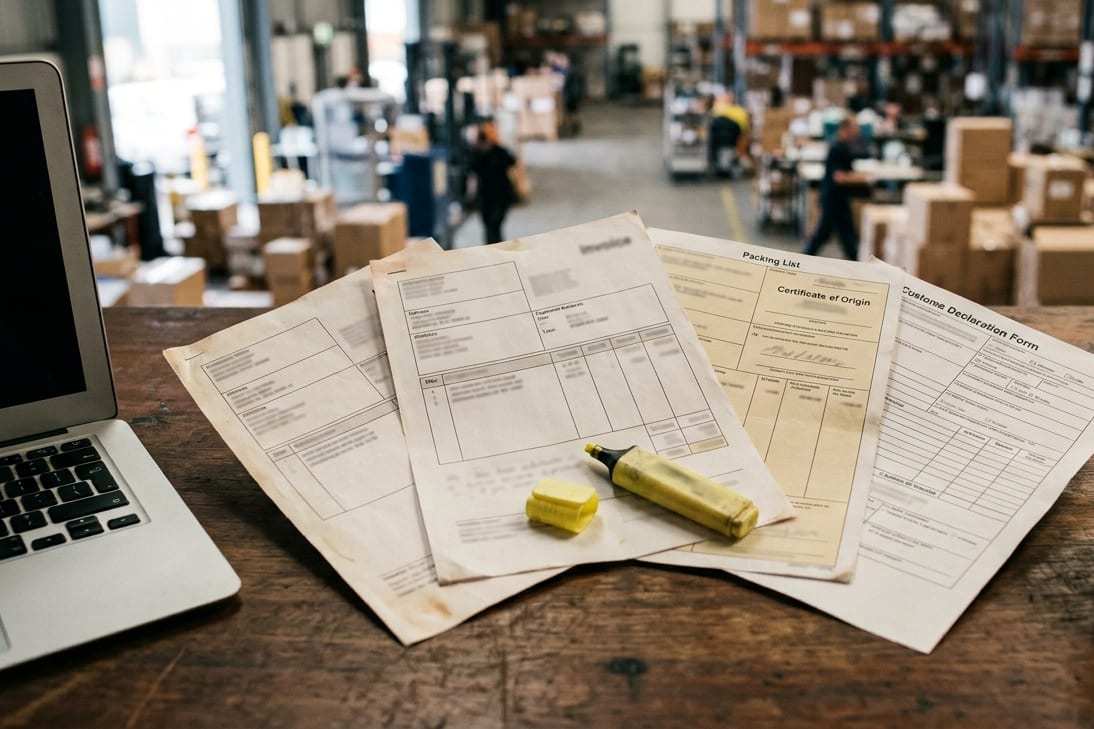
To review a consignment we need:
Consignments are rarely stopped because the goods are wrong. They are stopped because four documents that each look correct do not say the same thing, or because a certificate that is genuinely valid does not name the right consignee or list every model in the container.
None of that is difficult to find. It is only difficult to find late. The whole value of this review is its position in the sequence: after the file is complete enough to check, and before anything has been committed that costs money to reverse.
One document, written to be forwarded to a supplier unedited — not a conversation about risk.
One line at the top of the report: ship, ship after these fixes, or do not book yet. Everything below it is the reasoning. We do not hedge the headline.
Consignee, HS code, model, description, quantity, weight and value compared across every document in the set, with each disagreement shown side by side.
Whether the conformity document is live, whether it names your consignee, and whether the models it lists are the models actually in the container.
Mandatory Arabic content, origin marking and category-specific markings checked against the regulation the product falls under — while artwork can still be corrected.
Confirmation that the code on the draft invoice is the code the certificate was issued against, and that it is defensible at Saudi tariff depth.
Each finding assigned to the party who can actually resolve it — supplier, importer, forwarder or us — with what has to change and in what order.
Seven steps, in this order, because each one depends on the answer before it. The engagement closes on the re-check, not the first report.
You send the draft set as it stands. Incomplete is fine and is itself a finding; we would rather see the real file than a tidied one.
The declared code is tested against the goods and against the code the certificate was issued under. Everything downstream depends on these being the same code.
Validity, consignee, scope and model coverage. A live certificate that names the wrong party or omits a variant is the most common single finding.
Invoice, packing list, origin certificate and conformity document read as one statement. Customs will read them that way; we do it first.
Checked against the applicable regulation from artwork files or carton photographs, including the markings that only apply to certain categories.
The go/no-go, the reconciliation table and the fix list, in one document you can forward to the supplier without rewriting it.
Corrected documents come back through the same checks. The engagement closes on a clean pass, not on the first report.
Drafts are fine and gaps are informative. A tidied set hides exactly the things the review exists to find.
Six recurring findings. All six are invisible in a document set read one document at a time.
The certificate names a trading name, a previous distributor or a group company rather than the CR the declaration will be lodged under.
Usually a suffix change or a variant added late in production. The paperwork is genuine and does not cover part of the shipment.
The invoice carries the supplier’s code, the certificate carries another, and nobody compared them until the declaration was lodged.
Translated marketing copy on the pack, but a mandatory element left out because the translator was never given the requirement.
Valid on the day it was checked and not on the day of arrival. Sailing time is part of the validity question and is regularly left out of it.
Packing list cartons against invoice units against certificate quantities. Small discrepancies are the ones that trigger a physical examination.
Identical findings. What changes is where the goods are standing when you learn about them.
A proven route with an unchanged product rarely needs a review. These six are not that.

A new consignee means a new set of details to get wrong, and the first consignment sets the pattern the next ten will copy.
The route is proven, the product is not. Added lines are the most common way a clean shipping history acquires its first hold.
A model suffix, a component, a supplier of a component, a new production site. Any of these can leave the certificate describing the previous version.
Where validity and arrival date are close together, the check is about the arrival date, not today’s.
Several product lines, potentially several regulators. The consolidated document set has to work line by line, not on average.
A consignment held once will be looked at again. The next shipment is the one that has to be unarguable.
A consignment that was three days from a booking, with a complete and entirely genuine document set.
Draft invoice, packing list, a live conformity certificate and carton photographs. The importer had shipped the same product line twice before without incident.
Quantities, weights, values and origin all agreed. The certificate was valid, correctly issued and named the right consignee.
The packing list carried two part numbers ending in a revision suffix the certificate did not list. The factory had rolled a component change four weeks earlier.
Roughly a fifth of the container was not covered. On arrival that is a physical examination, a partial hold and a retroactive amendment with storage running throughout.
The certificate was amended at origin before booking. The vessel moved by four days, the file cleared normally, and the revision is now on the supplier’s change checklist.
This is the check itself. Run it yourself on a simple consignment — the review exists for the ones where you cannot answer point four with certainty.
What feeds this review, and what to do when it finds something structural.
Scope, timing and turnaround. Regulatory what-applies questions live on the product compliance page.
After the goods are made and the documents are drafted, but before freight is booked. That window is where every finding is still cheap to fix: artwork can be reprinted, documents reissued and certificates amended without anything being in transit.
A single-product consignment with a complete set is usually turned around within one working day. Mixed containers and files with gaps take longer, and we tell you which of the two you have when the set arrives rather than at the end.
No. The review runs on documents and photographs. Where something can only be settled by looking at the goods — a marking that cannot be read from a photo, a pack that does not match the artwork — we say so and it becomes a separate inspection.
No, and they answer different questions. An inspection looks at the goods: quantity, condition, workmanship. This review looks at the file: whether the documents, the certificate and the labelling agree with each other and with the regulation. Both are useful; only one of them catches a consignee mismatch.
Then that is the report, stated in the first line. It is an uncomfortable message three days before a booking and a much cheaper one than the alternative. The fix list sets out what would have to change for the answer to become yes, and we re-check once it has.
Yes, and it is usually faster. Several findings can only be resolved at origin — a reissued certificate, corrected artwork, an amended invoice — and going through a buyer as intermediary adds a day to each round trip.
Very little. Forwarders check that documents exist and that the booking can be made; the reconciliation between a certificate scope and a packing list sits outside what they are engaged to do. Most of our findings are ones a forwarder would not be expected to look for.
Yes. A large share of this work is on files prepared elsewhere, and the review is deliberately sold as a standalone check. If the file is sound we say so — that is a legitimate outcome, not a failed engagement.
For regular shippers it usually should be. A standing gate on every consignment costs less per shipment, and by the third or fourth review most of the recurring findings have been engineered out of the supplier’s process entirely.
Invoice, packing list, certificate and label artwork is enough. Most single-product consignments are answered within one working day.