A minimum to pass, not only a rating to display
The label shows how efficient a product is, but the regulation also sets a floor. A model below the minimum for its class cannot be sold at all — no label, no certificate, no import.
The energy card is the part of an appliance file that most often decides the schedule, and occasionally decides whether the model can be sold here at all. It is measured separately from safety, at high ambient conditions, and the number that comes back is printed on the product.

Send to check an energy requirement:
Six things worth settling before an energy programme is quoted, and the first is the one that catches people.
The label shows how efficient a product is, but the regulation also sets a floor. A model below the minimum for its class cannot be sold at all — no label, no certificate, no import.
Energy performance is measured under prescribed conditions that have nothing to do with the safety programme. It is a separate report, often from a different laboratory, and usually the longest test in the file.
Cooling performance is rated at high ambient temperatures. A unit rated well against a temperate test cycle can fall a band or more when it is measured the way this market measures it.
Layout, colours, Arabic text, the star scale and the declared figures follow a prescribed format. It is not a marketing asset to be redrawn, and a redrawn one is rejected.
The energy result and the label artwork are assessed as part of the product certificate work for regulated categories, not as a separate application afterwards.
Labelled products are bought off the shelf and retested. A declared figure the product does not meet is a market withdrawal question, not a paperwork correction.
The scheme has grown category by category. These are the families it reaches today, and what each is rated on.
Split, window and packaged units — the category the programme was built around. Both the minimum efficiency and the high ambient rating bite hardest here.
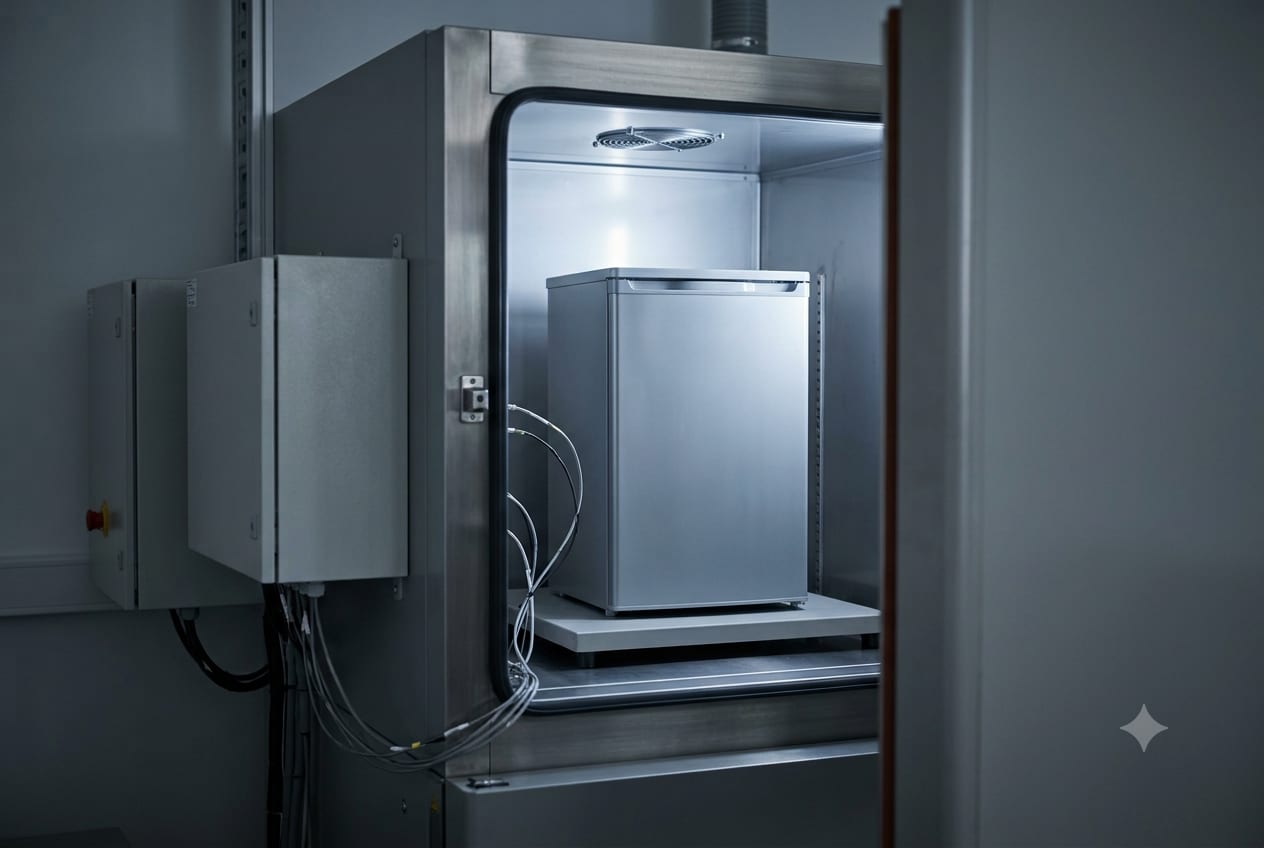
Household cold appliances, rated on annual energy consumption against volume. Long test cycles make this the slowest energy programme to schedule.
Rated on consumption per cycle at a defined programme. Water consumption is assessed alongside energy for several product types.
Storage and instantaneous heaters, assessed on standing losses and heating performance, with insulation quality dominating the result.
Lamps and luminaires rated on efficacy in lumens per watt, with lifetime and performance claims assessed alongside the efficiency figure.
Rolling resistance, wet grip and noise, carried on a label of their own. The requirement sits with the tyre regulation and is handled with that certification.
Televisions, ovens, fans and further categories have been brought into the scheme over time. Whether yours is scheduled is a question for the regulation in force, not a list from two years ago.
Larger cooling plant and motors carry efficiency requirements of their own, on a different footing from the consumer label.
Exporters plan for the left column and are surprised by the right. They run in parallel or the schedule doubles.
Five steps. Step two costs an afternoon and occasionally saves an entire testing programme.
The regulated list is defined by product category and HS code, and it has grown over the life of the programme. Confirm from the regulation in force whether your model is in scope before planning anything else.
There is a threshold below which the product cannot be sold, and it rises over time. Checking your existing performance data against the current floor takes an afternoon and occasionally saves an entire programme.
Energy testing is run under prescribed conditions at a laboratory accredited for the method, including the high ambient conditions this market rates against. Cycle times here are measured in days per unit, not hours.
The card is generated from the tested figures in the mandated layout, in Arabic, with the correct scale and class. Artwork is proofed against the format rather than adapted from the label used in another market.
The energy evidence joins the conformity file for the product certificate, and the label is applied to the product as sold. When the thresholds move, the rating is re-established rather than assumed.
Ten items. The last two are where ranges come apart, because each model carries its own declared figures.
An air conditioning manufacturer with six capacities in one split unit family, holding efficiency data generated for a European rating scheme.
All six capacities were inside the scheme, and the minimum threshold applied to each of them separately rather than to the family.
The European figures had been generated at a lower ambient temperature. Recalculated against the local rating conditions, two capacities fell below the floor.
The two failing capacities were dropped from the Saudi offer rather than tested, and the specification for one of them was revisited for the following season.
The remaining four were energy tested while the safety file was assessed, so the energy result did not extend the programme.
Four labels in the mandated format, each carrying its own tested figures, applied to the units as sold and filed with the conformity evidence.
Six failures. The first costs weeks, the third costs the model, and the last one arrives at renewal.
The safety result arrives, and only then does energy testing begin. Run in sequence rather than in parallel, it adds its entire duration to the end of the programme.
A figure generated for a cooler market, presented for a market that rates at high ambient. The number drops when it is measured correctly, and the label has to follow the measurement.
Exporters plan for a modest star rating and discover the model is under the floor. At that point it is a product decision, not a certification one.
Colours adjusted, Arabic reset, the scale simplified for a cleaner pack. The format is prescribed, and a redrawn card is rejected however good it looks.
Capacities within a family perform differently and band differently. Each model carries its own declared figures, and copying one across the range is a declaration you cannot support.
Minimums are raised on a schedule. A model certified two years ago can be below the current floor today, which is a renewal issue people meet for the first time at renewal.
The appliance file this joins, the tyre label beside it, and the renewal where thresholds catch up with you.
The energy programme specifically. The wider appliance file is answered on the electrical page.
It is the card carried by regulated appliances, air conditioning, lighting and tyres, showing the product is measured efficiency on a prescribed scale in Arabic. It serves two purposes at once: it tells the buyer how the product compares, and it evidences that the model meets the minimum efficiency the regulation requires for its class.
Air conditioners, refrigerators and freezers, washing machines and dryers, electric water heaters, lighting and tyres are the established categories, and further appliance types have been brought into the scheme over time. Because the list grows, whether your model is in scope is confirmed against the regulation in force rather than against an older summary.
The label is not a separate application. For regulated categories the energy test result and the label artwork are assessed as part of the conformity work behind the product certificate, and the certificate is registered on SABER as normal. What is separate is the testing: energy is its own programme with its own laboratory and its own schedule.
Rarely. Ratings depend on the conditions they were measured under, and Saudi Arabia rates cooling performance at high ambient temperatures. A figure produced for a temperate cycle usually falls when it is remeasured, so existing data is useful for planning but not for declaring.
It cannot be sold. The minimum is a threshold rather than a rating, and a model below it does not receive a certificate at any star level. When this comes up, the options are a specification change, a different model for this market, or leaving the capacity out of the range.
No. Layout, proportions, colours, Arabic text and the scale are prescribed, and the card is generated from the tested figures. Labels redrawn to suit packaging design are rejected, and a rejection at that stage usually means reprinting cartons.
Yes. Capacities and variants within a family consume differently and band differently, so each model carries its own declared figures and its own class. Applying one rating across a range is a declaration that cannot be supported when the products are retested.
Longer than safety testing, and the cycle times are fixed by the method rather than by laboratory capacity — refrigeration in particular runs for days per unit. For a range of several capacities, plan in weeks and start it in parallel with the safety work rather than after it.
Products already in the market are expected to meet the requirement in force, and a rating is re-established rather than carried forward indefinitely. In practice this surfaces at renewal: a model certified comfortably two years ago can sit below the current floor, which is why renewal for these categories is treated as a review rather than a formality.
Yes. Market surveillance buys labelled products and retests them, and a declared figure the product does not achieve is treated as a market issue rather than a documentation one — with withdrawal and importer consequences. The declared rating is worth being conservative about for exactly this reason.
Send your model list and whatever performance data exists. We confirm whether the category is in scope, read your figures against the minimum in force, and tell you which models are worth testing.