Central battery systems (CBS)
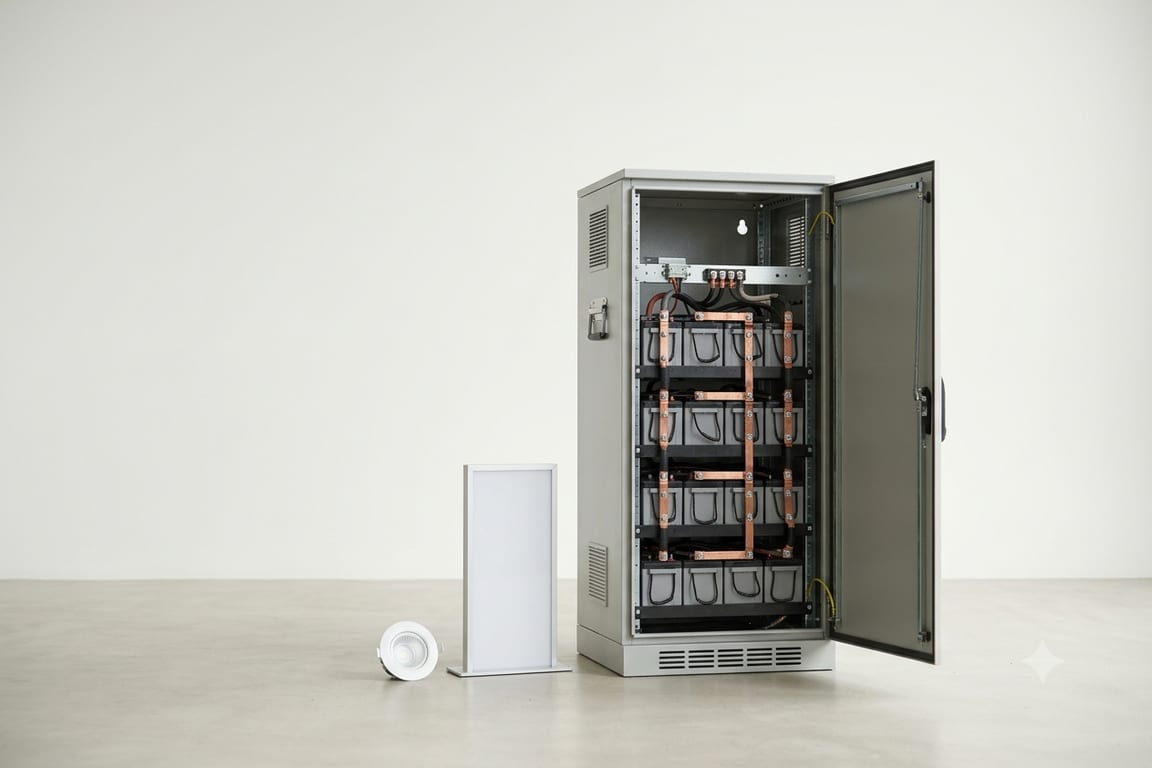
Central units supplying slave luminaires over a dedicated circuit. The system, its changeover and its monitoring are assessed together.
Exporting central battery systems or emergency luminaires to Saudi Arabia? BenzilaCert helps manufacturers and exporters evidence the declared duration and emergency output, confirm which emergency lighting standard applies, and prepare the testing and model list for SABER certification.
Send to scope an emergency file:
The distinguishing question for this category is simple: does the product have to keep working when the mains fails?
Central units supplying slave luminaires over a dedicated circuit. The system, its changeover and its monitoring are assessed together.
Fittings with an integral battery and inverter. The emergency function and the declared duration are what define the product.
Maintained and non-maintained signage, where legibility distance and the declared duration both form part of the evidence.
Modules that add an emergency function to an ordinary fitting. Supplied separately, they are products in their own right.
Uninterruptible supplies used for emergency and standby duty, assessed on changeover behaviour and declared autonomy.
A fitting with no emergency function follows the normal lighting route. That is covered on our LED lights page.
Emergency is a function, not a product feature
Six factors that separate one emergency file from another, read from the declared performance rather than the product name.
| Factor | Why it changes the answer |
|---|---|
| Central or self-contained | A central system feeding slave fittings and a fitting with its own battery are different products |
| Declared emergency duration | The declared autonomy — commonly one or three hours — is a tested performance claim and defines the model |
| Maintained or non-maintained operation | Whether the lamp is lit in normal conditions changes the assessment and the declared duty |
| Battery chemistry and arrangement | Chemistry, capacity and whether cells are replaceable affect both the assessment and the shipping arrangements |
| Changeover and monitoring function | Automatic test and monitoring functions are assessed in addition to the lighting output |
| Supplied as a module or a complete fitting | A conversion module sold separately is its own product, not an accessory of a luminaire |
We do not publish an HS code for emergency equipment, because the code follows the product specification rather than the category. Central systems, self-contained luminaires, conversion modules and static converters can classify differently, and the classification is what determines the applicable regulation. It is confirmed per family — see our HS code check.
What may apply to an emergency file, and what is confirmed rather than assumed.
Where the confirmed classification falls under an applicable Saudi technical regulation, the product generally needs a certificate registered on SABER, followed by a shipment certificate for each consignment. The product certificate is issued by an approved conformity assessment body against the technical file and the test evidence.
Emergency products are assessed against the emergency lighting family in addition to the general luminaire requirements. Which standard and which edition is named for a particular product is confirmed from the applicable regulation rather than assumed, because a report to a superseded edition is a common gap.
Separately from certification, lithium cells carry dangerous goods transport obligations. Those are a logistics requirement rather than part of the product certificate, but they are planned at the same time because they affect how and when the consignment can move.
Each declared duration is its own claim
Checks an emergency assessment commonly draws on. Which apply depends on the product and the standard edition the regulation names.
| Check | What it looks at |
|---|---|
| Emergency duration | Light output sustained across the declared autonomy, from a defined state of charge |
| Photometric output in emergency mode | Declared emergency lumen output, which is not the normal-mode output |
| Changeover operation | That the unit transfers to emergency supply within the declared time on mains failure |
| Battery charging and recovery | Recharge behaviour and the declared recovery period after discharge |
| Electrical safety | Construction, insulation and protection against electric shock |
| Electromagnetic compatibility (EMC) | Emissions produced, and immunity to interference |
| Endurance and battery life | Behaviour over declared life and repeated discharge cycles |
| Automatic test function | That self-test and fault indication operate as declared, where fitted |
Testing is carried out by laboratories accredited for the relevant tests. Duration testing occupies laboratory time for the full declared period per variant, which is why a range with several durations takes longer to clear than a range with one.
What an emergency submission is built from. The emergency-mode output, stated separately from normal output, is the line most often missing.
Send the model list with declared durations and emergency outputs, plus the reports you hold. We will check whether the evidence reaches the declared period for each variant.
Five steps from separating the emergency range to certified consignments.
Products with an emergency function are split from normal fittings, because the declared duration and the battery are what the assessment turns on.
Confirm the Saudi HS code per family, then the applicable technical regulation and which emergency lighting standard and edition is named for it.
Check existing reports against the declared autonomy, emergency-mode output and changeover behaviour, and identify the remaining testing.
Prepare the technical file and the model list, then submit for assessment by the approved certification body.
Each consignment is applied for against the product certificate, with battery transport documentation arranged alongside where lithium cells are shipped.
Separate the government fees from the body, testing and service charges before comparing quotations.
Four things move the cost of an emergency programme: how many declared durations the range offers, how much of the required testing the existing reports already cover at the declared period, whether central systems need circuit-level assessment, and the number of consignments needing shipment certificates and battery transport documentation.
Government and SADAD fees, conformity body charges, laboratory testing and service charges are separate lines and are quoted separately. Our SABER certificate cost page sets out how those lines work. We do not publish a flat price or a guaranteed turnaround for an emergency file, because duration testing time depends on the range itself.
Six issues we see repeatedly on central battery and emergency lighting submissions.
A three-hour claim needs a report demonstrating three hours at the declared output. Carrying a duration across from a datasheet is the most common gap on these files.
Emergency-mode light output is substantially lower than normal output and is declared separately. Quoting one figure for both is found immediately at review.
Emergency luminaires carry function and duration requirements that ordinary fittings do not. Submitted inside a general lighting family, they are separated out.
A module that adds an emergency function and is sold separately is a product in its own right, not a spare part of a luminaire.
Lithium cells carry dangerous goods transport obligations independent of certification. Discovering that at booking rather than at planning delays the consignment, not the certificate.
A central battery system is assessed with its circuit arrangement. Without the single-line detail and the slave fitting information, the file cannot be completed.
Ordinary lighting, drivers, detection equipment, and the certificate a family ends up on.
How emergency products differ from ordinary fittings, what a duration claim must prove, conversion modules, battery documentation and grouping.
Where the confirmed Saudi HS code for the product falls under an applicable technical regulation, it generally needs a product certificate registered on SABER and then a shipment certificate per consignment. Emergency products are assessed on their emergency function, so they are not simply folded into a general lighting file.
Yes, in substance. An ordinary fitting is assessed on safety, EMC and photometric performance. An emergency fitting is additionally assessed on declared duration, emergency-mode output, changeover behaviour and the battery. Ordinary lighting is covered on our LED lights page.
That the declared light output is sustained for the full declared period from a defined state of charge. A one-hour or three-hour claim is a tested performance figure, and reports that stop short of the declared duration do not support it.
If it is sold separately, generally yes — it is a product in its own right. A module supplied only built into a complete fitting is usually assessed as part of that fitting. Ranges sold both ways need both.
The battery specification forms part of the product file, and where lithium cells are used there are separate dangerous goods transport obligations for shipping them. Those are a logistics requirement rather than part of the product certificate, but they are planned at the same time because they affect the consignment.
Variants sharing construction, battery arrangement and standards can often be grouped, subject to the certification body accepting it. Different declared durations are one of the things that most often splits a proposed family, because each duration is a separate tested claim.
The commercial invoice and packing list with model numbers exactly as certified, the product certificate reference, battery transport documentation where applicable, and the transport and origin documents as they become available. Our SABER documents checklist sets out the full list.
Send the model list with declared durations, emergency outputs and battery details, plus any test reports you hold. We will review what the evidence actually supports and what is still open.
Tell us about the emergency systems or luminaires you ship, their declared durations and battery arrangement. We reply within one business day with the likely route and what to send next.