Constant-current LED drivers
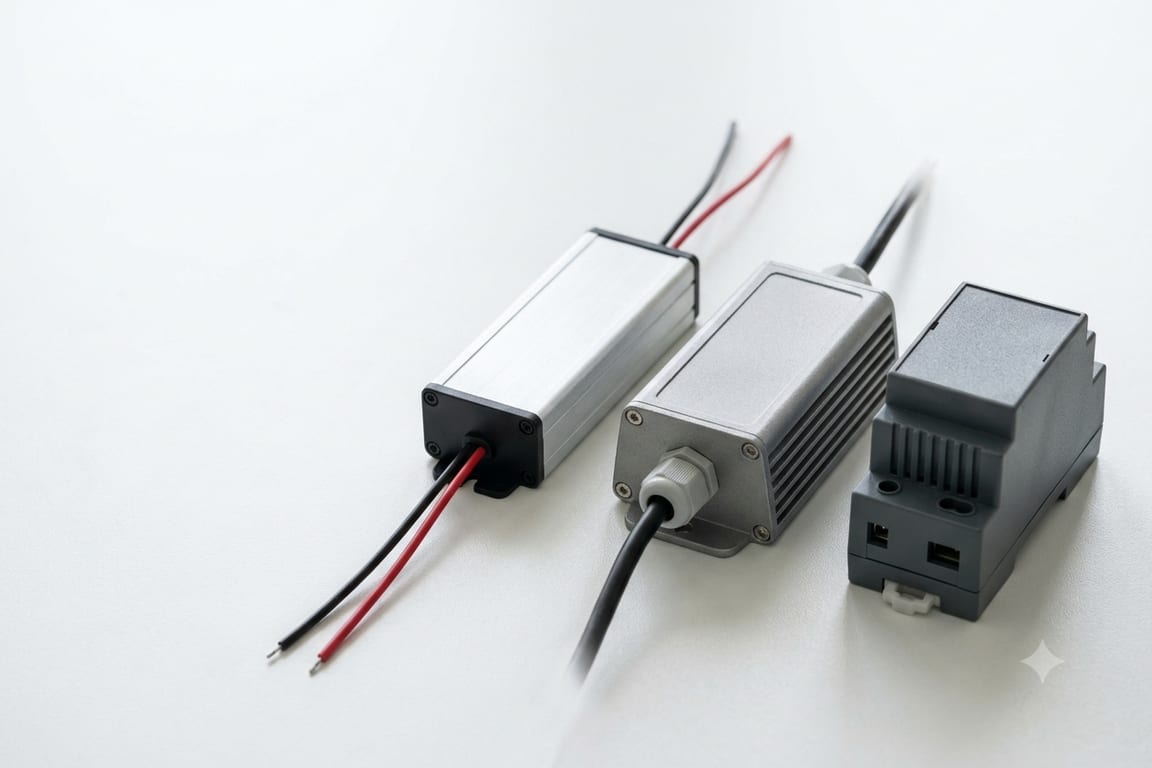
Drivers that hold a fixed output current. The declared current and the output voltage window are what define the model, not the fitting it ends up in.
Exporting LED drivers or power supplies to Saudi Arabia? BenzilaCert helps manufacturers and exporters confirm how each unit is classified, which Saudi technical regulation applies, what testing the declared output ratings need, and how the model range can be grouped for SABER certification.
Send to scope a driver file:
This page covers the driver or power supply supplied as its own product. A driver sealed inside a complete fitting follows the luminaire instead.
Drivers that hold a fixed output current. The declared current and the output voltage window are what define the model, not the fitting it ends up in.
Fixed-output-voltage units, commonly 12 V or 24 V, used for strip and modular lighting. Often supplied as a general power supply rather than as lighting controlgear.
Units with a dimming interface. The control protocol and any wireless interface are assessed in addition to the power electronics.
General-purpose AC/DC supplies, including DIN-rail and enclosed units, that are not specific to lighting but share the same assessment questions.
Potted or enclosed units declared for wet or outdoor locations, where the ingress protection rating forms part of the evidence.
A driver sealed inside a complete fitting is generally assessed as part of that fitting. That route is covered on our LED lighting page.
Separate product or part of a fitting
Six factors that move a driver between regulations and between certificates. Each is confirmed from the specification, not from the category name.
| Factor | Why it changes the answer |
|---|---|
| Supplied separately or built in | A driver sold as its own product and a driver sealed inside a luminaire are generally not the same submission |
| Lighting controlgear or general power supply | A unit specific to LED light sources and a general-purpose AC/DC supply can point at different regulations |
| Rated output power | The declared wattage, and the range across a model family, affects both grouping and which checks apply |
| Output characteristic | Constant current and constant voltage behave differently and are declared differently |
| Control and communication interface | A dimming or wireless interface can bring additional screening beyond the power electronics |
| Declared location of use | Indoor, outdoor or wet-location claims bring the ingress protection rating into the evidence |
We do not publish an HS code for drivers and power supplies, because the code follows the specification of the unit rather than the product family. Lamp controlgear, general-purpose power supplies and parts can classify differently, and the classification is what determines the applicable regulation. It is confirmed per family — see our HS code check.
What may apply to a driver file, and what is decided per product rather than across the category.
Where the confirmed classification falls under an applicable Saudi technical regulation, a driver generally needs a product certificate registered on SABER, followed by a shipment certificate for each consignment. The product certificate is issued by an approved conformity assessment body against the technical file and the test evidence.
Beyond that base route, three things are assessed per product rather than assumed. Whether the IECEE route applies depends on the current national recognition scope for the unit in question. Whether any energy-efficiency obligation reaches a separately supplied driver depends on the current scope of that programme. And where a driver carries a wireless control interface, screening beyond the electrical regulation may apply.
None of those three follows automatically from the product being a driver, so we confirm each against the current published scope before a route is committed to.
Assess each model family separately
Checks a driver assessment commonly draws on. Which apply depends on the unit and the standards the applicable regulation names.
| Check | What it looks at |
|---|---|
| Electrical safety | Construction, insulation, creepage and protection against electric shock |
| Electromagnetic compatibility (EMC) | Emissions produced, and immunity to interference |
| Output performance | Declared output current or voltage, regulation and ripple against the datasheet |
| Input power and power factor | Input current, power factor and efficiency against the declared rating |
| Abnormal and fault conditions | Behaviour under overload, short circuit and open-circuit output |
| Thermal performance | Case temperature at rated load, and the declared maximum ambient |
| Endurance | Operation over the declared life at rated load |
| Ingress protection (IP) | Dust and water protection — where an outdoor or wet-location claim is declared |
Testing is carried out by laboratories accredited for the relevant tests. Any standard named for a specific driver is confirmed for that exact unit and its current edition before it is relied on — a report to a superseded edition is one of the more common gaps found at review.
What a driver submission is built from. The output declarations are the part most often incomplete.
Send the reports with the model list and the declared output ratings. We will check what the existing scope covers against the range you ship, and what testing is still open.
Five steps from the model list to certified consignments.
Models supplied as standalone products are split from drivers that only ever ship inside a luminaire, because they do not follow the same submission.
Confirm the Saudi HS code per family, then whether the unit is treated as lamp controlgear or as a general power supply, and which technical regulation follows.
Check what existing reports cover against the declared output ratings, power range and control functions, and identify the remaining testing.
Prepare the technical file and the model list, then submit for assessment by the approved certification body.
Each consignment is applied for against the product certificate, with the invoice models matching the certified list exactly.
Separate the government fees from the body, testing and service charges before comparing quotations.
Four things move the cost of a driver programme: how many model families the range splits into after grouping, how much of the required testing the existing reports already cover, whether an outdoor or wireless claim brings additional checks, and the number of consignments needing shipment certificates.
Government and SADAD fees, conformity body charges, laboratory testing and service charges are separate lines and are quoted separately. Our SABER certificate cost page sets out how those lines work. We do not publish a flat price or a guaranteed turnaround for a driver file, because both depend on the grouping and the testing gap.
Six issues we see repeatedly on driver and power supply submissions.
A driver that is also sold separately is a product in its own right. Covering it only as a component of a fitting leaves the separately sold stock without a certificate behind it.
A family spanning a wide output range is one of the most common groupings a certification body reduces, because the construction and the thermal behaviour change across it.
The two have different output declarations and different test evidence. Grouped together, the file usually comes back for separation.
Where the label, the datasheet and the test report state different output ratings, the inconsistency is found at review rather than at the border.
A driver with a radio interface can need screening beyond the electrical regulation. Leaving the function out of the declaration is found later, not sooner.
An IP rating printed on the label but absent from the test report is treated as an undeclared claim.
The lighting category this sits beside, and the certificates a driver family ends up on.
Separate versus integral drivers, output-power grouping, general power supplies, dimming interfaces and the shipment stage.
Where the Saudi HS code for the driver falls under an applicable technical regulation, the product generally needs a certificate registered on SABER and then a shipment certificate per consignment. It is decided by the classification of the unit rather than by the product name, so it is confirmed per family.
It depends on how it is supplied. A driver sealed inside a complete luminaire is usually assessed as part of that fitting. A driver sold on its own — as a spare, a replacement or a component for assembly — is generally a product in its own right and needs its own evidence.
Sometimes, where the models share construction, the same circuit platform and the same standards, and subject to the certification body accepting the grouping. A wide output power range and a mix of output characteristics are the two things that most often cause a proposed family to be split.
Not necessarily. A unit specific to LED light sources may be treated as lamp controlgear, while a general AC/DC supply can fall under a different regulation even when it is used in a lighting installation. The declared purpose and the classification decide it.
The dimming interface is assessed in addition to the power electronics. Where the driver includes a wireless control function, additional screening beyond the electrical regulation may apply, so the interface is declared at the start rather than discovered during review.
Possibly in part. Reports to the standards the applicable regulation names, from a laboratory accredited for those tests, may support the file. The approved certification body decides what it accepts, and gaps are usually about the scope of the report against the declared range rather than about the laboratory.
The commercial invoice and packing list with model numbers exactly as certified, the product certificate reference, and the transport and origin documents as they become available. Our SABER documents checklist sets out the full list.
Send the model list with output ratings, whether each unit ships separately or inside a fitting, and any test reports you hold. We will review the likely classification and grouping, and what evidence is missing.
Tell us about the drivers and power supplies you ship, their output ratings and whether they are sold separately. We reply within one business day with the likely route and what to send next.