Recessed LED downlights
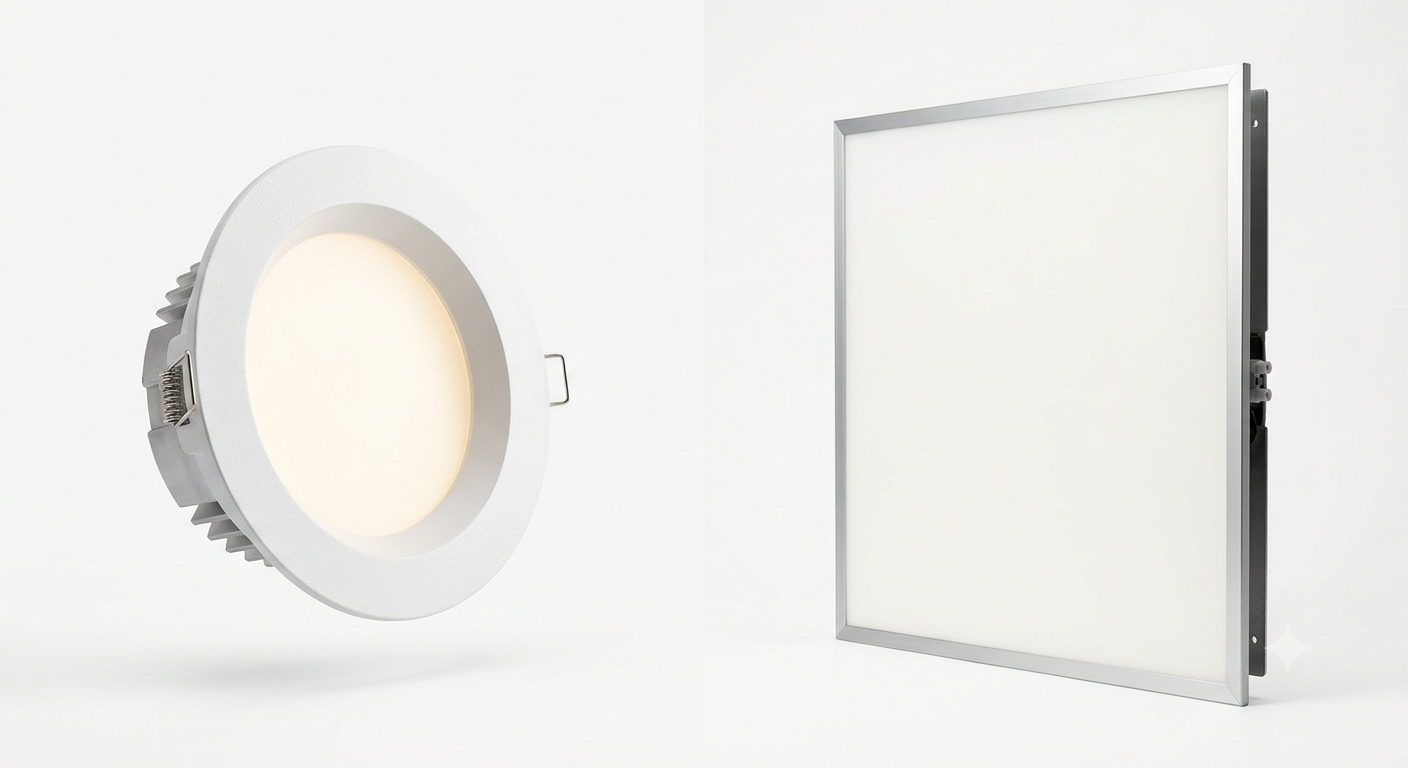
Ceiling-recessed fixed and adjustable downlights, assessed on the cut-out diameter, the reflector or diffuser and the rated wattage. The driver may be integral or remote.
Exporting LED downlights or ceiling panel lights to Saudi Arabia? BenzilaCert helps manufacturers and importers assess the applicable luminaire classification, cut-out dimensions, driver requirements, test evidence and SABER certification route.
Send to scope a downlight or panel file:
Recessed downlights, flat panels and troffer fixtures are not the same product for certification.
Ceiling-recessed fixed and adjustable downlights, assessed on the cut-out diameter, the reflector or diffuser and the rated wattage. The driver may be integral or remote.
Flat ceiling panels — surface-mounted, recessed or suspended — where the panel dimension, the light-guide plate and the edge-lit or back-lit design define the product.
Low-profile fixtures designed for shallow ceiling voids. The reduced depth drives the driver configuration and thermal management.
Downlights with an integrated fire barrier, where the fire rating and the IP rating must both be supported by test evidence.
Grid-ceiling troffer luminaires for offices and commercial interiors. Standard sizes (600 × 600, 1200 × 300) classify within the same family but the driver platform may differ.
LED downlights and panel lights are commonly assessed under the technical regulation covering lighting products.
LED downlights and panel lights fall within the scope of lighting product regulations administered by SASO. Whether a specific fixture is assessed under the IECEE lighting scheme, a SABER PCoC route or another path depends on the Saudi HS code and the current regulation.
The driver inside a downlight is normally assessed as part of the luminaire. A standalone external driver shipped separately may need its own assessment — see LED drivers & power supplies.
Recessed downlights and surface-mounted panels may classify under different headings.
A shipment mixing recessed downlights and flat panels can carry different classifications. Confirm the exact Saudi HS code before assigning the certification path — see our HS code check.
Seven checks a downlight or panel assessment may draw on.
| Check | What it looks at |
|---|---|
| Electrical safety | Protection class, insulation and temperature rise per IEC 60598-2-2 or the applicable part |
| Photometric performance | Luminous flux, efficacy, UGR and colour rendering from the integrating sphere or goniophotometer report |
| Thermal endurance | LED and driver temperature at rated ambient, especially for recessed units with restricted airflow |
| IP ingress protection | Dust and moisture resistance where the declared IP rating exceeds IP20 |
| EMC compatibility | Electromagnetic emission and immunity per applicable standards |
| Driver safety | Separate driver report where the driver is assessed as a standalone component |
| Fire rating | Fire-barrier test evidence for fire-rated downlights where applicable |
What the safety and photometric reports establish, and what else is needed.
The IEC 60598-2-2 safety report, the photometric report, the driver specification and the installation instructions form the core of a downlight or panel technical file. Fire-rated models need additional fire-barrier evidence.
Send the wattage, cut-out size, driver type and installation method. We will confirm the applicable route before you commit to testing.
Five steps, from classification to shipment documentation.
Recessed downlights, surface panels and troffer fixtures may classify under different headings. The Saudi HS code and the installation type determine the route.
Check whether the product falls under the IECEE lighting scheme, SABER PCoC or another route based on the current regulation.
Match the evidence against the declared specifications: wattage, lumen output, cut-out size and driver family.
Prepare the technical file and apply for assessment. Factory inspection may apply depending on the scheme.
Each consignment is documented with models, wattages and quantities matching the certification in place.
Driven by the luminaire type, the number of models and the certification route.
The SABER platform fee, the certification body’s assessment, laboratory testing, factory audit where it applies and professional assistance are charged separately.
We quote per file and do not give guaranteed completion dates. See SABER certificate cost for how a quotation is itemized.
Six recurring issues in downlight and panel light files.
The driver brand or model was substituted after the original assessment. Driver changes usually require a review even if the wattage is the same.
A 6-inch and an 8-inch downlight share a test report intended for one cut-out. Each size with different optics needs its own data.
A "fire-rated" label on the packaging with no fire-barrier test report. The fire rating must be supported independently.
The downlight has a built-in driver but the application treats it as if a standalone driver certificate is needed — or the reverse.
A UGR < 19 claim on the datasheet with no supporting photometric calculation in the test report.
A 1200 × 600 panel shipped under a report that tested only the 600 × 600 version. Different panel sizes are not automatically covered.
The parent electrical category, the LED lighting hub, LED drivers and the certificates these products are assessed toward.
IECEE scope, driver assessment, size grouping, fire rating and factory inspection.
LED downlights and panel lights are generally covered by a technical regulation that requires certification registered on SABER. The applicable route depends on the classification and the current rules.
Lighting products may fall within the IECEE mutual recognition scheme. Whether it applies to a specific downlight or panel is confirmed from the current SASO scope list.
A recessed downlight and a flat ceiling panel are different product types even if they share a driver. Each type is classified and assessed on its own terms.
Models sharing the same driver platform, LED module and construction may be grouped. Models with different cut-out sizes, different optics or a different panel dimension are usually assessed separately.
Some certification routes include a factory evaluation. Whether it applies is settled at classification and depends on the scheme.
An integral driver is normally assessed as part of the luminaire. A standalone external driver shipped separately may need its own assessment — see our LED drivers page.
The product datasheet, photometric file, safety test report, driver specification, cut-out dimensions, product photographs and the Saudi HS code if known.
Send the wattage, cut-out size, driver details and installation method. We will review the classification, confirm the route and identify what evidence is missing.
Tell us the luminaire type, wattage and cut-out dimensions. We reply within one business day with the likely route and what to send next.