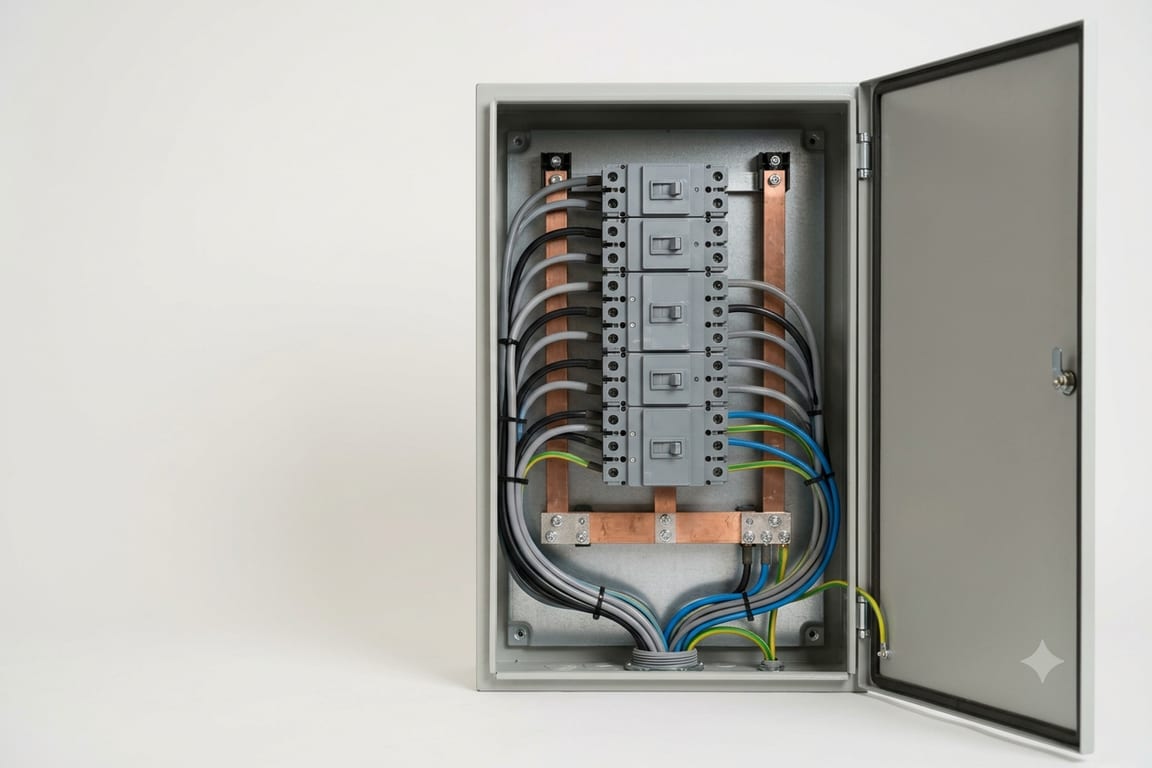
Main distribution boards (MDB)
Incoming boards at the head of an installation, where the short-circuit withstand and the busbar rating carry the assessment.
Exporting distribution boards or switchgear assemblies to Saudi Arabia? BenzilaCert helps panel builders and exporters confirm how the assembly is classified, which assembly standard applies, what the declared ratings must be supported by, and how board types can be grouped for SABER certification.
Send to scope an assembly file:
This page covers the finished assembly — the enclosure, the busbars and the ratings declared for the completed board.
Incoming boards at the head of an installation, where the short-circuit withstand and the busbar rating carry the assessment.
Downstream boards and consumer units. Usually the most repeated part of a project, and the easiest to group if the construction is consistent.
Assemblies containing starters, contactors and drives, where the functional units and the internal separation form part of the declaration.
Assemblies whose declared duty and thermal behaviour differ from a general distribution board.
Assemblies declared for outdoor service, where the enclosure ingress protection and the declared ambient conditions are part of the evidence.
A breaker, RCD or contactor supplied on its own is a product in its own right, not an assembly. That route is on our circuit breakers page.
The assembly is not the sum of its certificates
Six factors that change what a board must demonstrate. Each is read from the design, not from the product name.
| Factor | Why it changes the answer |
|---|---|
| Finished assembly or loose device | A completed board and the devices inside it are different products with different evidence |
| Declared ratings of the assembly | Rated current, rated voltage and short-circuit withstand are declared for the board, not inherited from its parts |
| Degree of internal separation | The declared form of separation changes the construction evidence the assembly needs |
| Enclosure and intended location | Indoor, outdoor and wet-location declarations bring the ingress protection rating into scope |
| Standard design or built to order | A repeated catalogue design and a one-off project board are presented differently |
| Origin of the type-test evidence | Whether the assembly derives from a verified type-tested design, and who holds that evidence, affects what must be demonstrated |
We do not publish an HS code for assemblies, because the code follows the construction and function of the board rather than the category. Complete assemblies, enclosures supplied empty and parts can classify differently, and the classification is what determines the applicable regulation. It is confirmed per assembly family — see our HS code check.
What may apply to a panel file, and what is confirmed per assembly rather than across the category.
Where the confirmed classification falls under an applicable Saudi technical regulation, an assembly generally needs a product certificate registered on SABER, followed by a shipment certificate for each consignment. The product certificate is issued by an approved conformity assessment body against the technical file and the design evidence for the assembly.
Assemblies are generally assessed against the low-voltage switchgear and controlgear assembly family, of which IEC 61439 is the common international reference. Which part of that family and which edition is named for a particular board is confirmed from the applicable regulation, because the parts cover different assembly types and a report to a superseded edition is a common gap.
Whether a factory audit applies depends on the conformity route the classification leads to and on the certification body’s requirements for the assembly type. It does not follow automatically from a product being a panel, so we confirm it before a timeline is committed to. See factory inspection for how an audit works where one is required.
Built-to-order boards need care
Checks an assembly assessment commonly draws on. Which apply depends on the board and the standard edition the regulation names.
| Check | What it looks at |
|---|---|
| Construction and clearances | Creepage, clearance and protection against electric shock within the assembly |
| Temperature rise | Behaviour of busbars and functional units at declared rated current |
| Short-circuit withstand | The assembly against its declared short-circuit rating |
| Dielectric strength | Insulation of the assembly under applied test voltage |
| Protective circuit continuity | Earthing continuity across the enclosure and functional units |
| Internal separation | That the construction matches the declared form of separation |
| Ingress protection (IP) | Enclosure protection against dust and water, where the location is declared |
| Mechanical operation | Operation of doors, interlocks and withdrawable parts where fitted |
Testing is carried out by laboratories accredited for the relevant tests. Where an assembly derives from a verified type-tested design, part of the evidence may come from that design rather than from testing the finished board — what can be relied on, and who must hold it, is confirmed with the certification body rather than assumed.
What a panel submission is built from. The drawing, the bill of materials and the rating plate must agree.
Send the single-line diagram, the BOM and the ratings you intend to declare. We will check whether the evidence supports them and how the board types are likely to group.
Five steps from the drawing set to certified consignments.
Finished boards are split from protective devices shipped on their own, because an assembly and a component are different submissions.
Confirm the Saudi HS code per assembly family, then the applicable technical regulation and which assembly standard and edition is named for it.
Check the single-line diagram, bill of materials and any type-test evidence against the ratings being declared, and identify what still needs demonstrating.
Prepare the technical file for the assembly family, then submit for assessment by the approved certification body.
Each consignment is applied for against the product certificate, with the invoice descriptions matching the certified assembly types.
Separate the government fees from the body, testing and service charges before comparing quotations.
Four things move the cost of a panel programme: how many assembly families the range splits into after grouping, whether existing type-test or verification evidence can be relied on, whether a factory audit applies to the route, and the number of consignments needing shipment certificates.
Government and SADAD fees, conformity body charges, laboratory testing and service charges are separate lines and are quoted separately. Our SABER certificate cost page sets out how those lines work. We do not publish a flat price or a guaranteed turnaround for an assembly file, because both depend on the grouping and on what design evidence already exists.
Six issues we see repeatedly on distribution board and switchgear submissions.
Certificates for the breakers inside a board do not certify the board. The assembly carries its own declared ratings, and this is the most common reason a panel file is sent back.
An assembly’s withstand rating is a property of the whole construction, not of its largest breaker. Declaring the device rating as the board rating is not accepted.
Where the single-line diagram, the bill of materials and the photographs disagree about what is fitted, the file stalls until they are reconciled.
Built-to-order boards that differ in ratings and separation are often submitted as one family. Grouping is usually reduced when the construction is not genuinely common.
A feeder pillar declared for outdoor service needs the ingress protection supported, not only printed on the rating plate.
The rating plate on the finished board is read against the technical file. Differences in rated current or withstand are found at review.
The devices fitted inside a board, and the certificates an assembly family ends up on.
Assembly versus device certificates, short-circuit ratings, assembly standards, grouping, factory audits and the shipment stage.
Where the confirmed Saudi HS code for the assembly falls under an applicable technical regulation, the board generally needs a product certificate registered on SABER and then a shipment certificate per consignment. It is decided by the classification of the assembly rather than by calling it a panel.
Usually the assembly file is expected to show that the protective devices fitted are themselves compliant products, so their certificates support the submission. They do not replace it — the assembly is assessed as its own product with its own declared ratings.
No. A certificate held by a device manufacturer covers that manufacturer’s product. A board built by a panel builder is a different product, and the panel builder is the one declaring the assembly ratings.
Assemblies are generally assessed against the low-voltage switchgear and controlgear assembly family, of which IEC 61439 is the common international reference. Which part and which edition is named for a particular assembly is confirmed from the applicable Saudi regulation rather than assumed, because the parts cover different assembly types.
Sometimes, where the boards share the same construction, enclosure system and declared ratings and only the number of ways differs. Boards that differ in short-circuit withstand, form of separation or enclosure type are usually separated by the certification body.
It depends on the conformity route the classification leads to and on the certification body’s requirements for the assembly type. It is not automatic for every board, and we confirm whether it applies before committing to a timeline.
The commercial invoice and packing list describing the assemblies exactly as certified, the product certificate reference, and the transport and origin documents as they become available. Our SABER documents checklist sets out the full list.
Send the single-line diagrams, the bill of materials and the ratings you intend to declare. We will review how the assemblies are likely to be classified and grouped, and what design evidence is missing.
Tell us about the assemblies you build, their declared ratings and the devices fitted inside them. We reply within one business day with the likely route and what to send next.