Miniature circuit breakers (MCB)
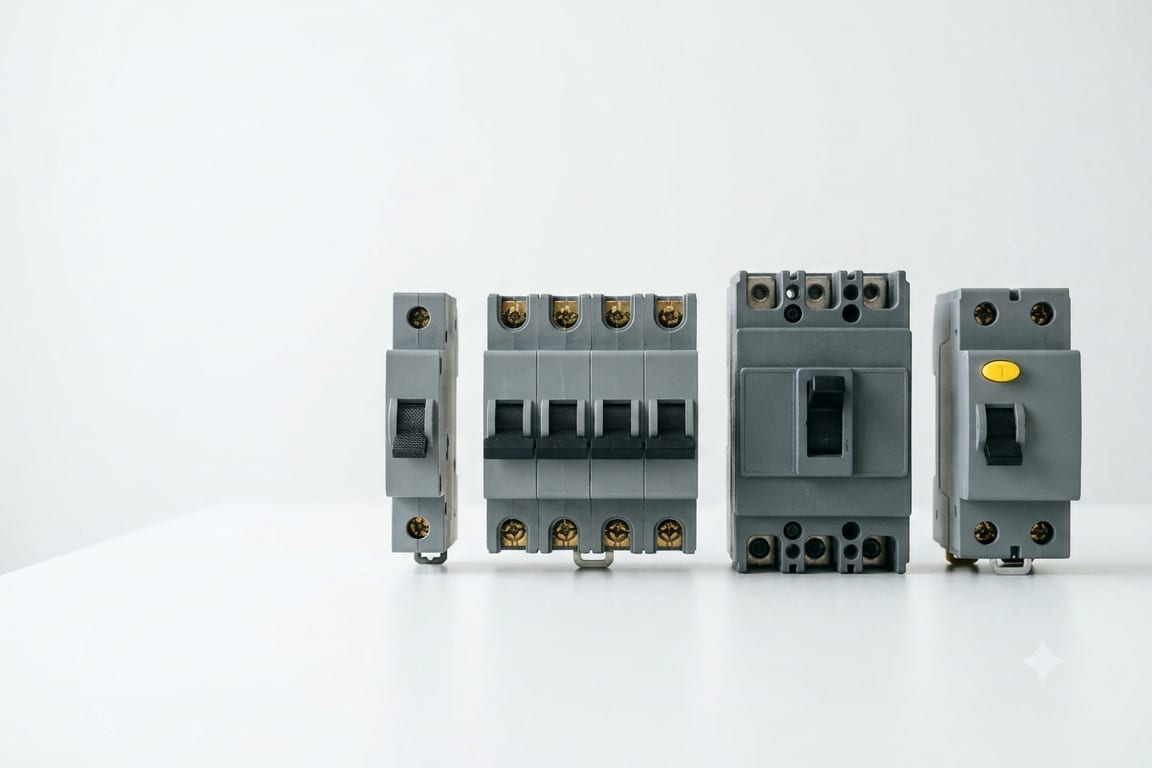
Household and similar devices. Defined by pole count, rated current, tripping characteristic and rated breaking capacity.
Exporting circuit breakers or residual current devices to Saudi Arabia? BenzilaCert helps manufacturers and exporters separate the device families, confirm which standard applies to each, check that declared breaking capacities are supported, and group model ranges for SABER certification.
Send to scope a breaker file:
This page covers the device supplied on its own. Each family below is assessed separately — they are not one catalogue.
Household and similar devices. Defined by pole count, rated current, tripping characteristic and rated breaking capacity.
Industrial devices at higher ratings, often with adjustable trip units that form part of the declaration.
Earth-leakage protection without overcurrent protection. The declared residual operating current and type are what define the model.
Residual current protection with integral overcurrent protection — assessed against both functions, not one.
Larger withdrawable breakers and isolating switches, where the operating mechanism and utilisation category matter.
A completed board containing these devices is an assembly with its own declared ratings. That route is on our electrical panels page.
Loose devices and fitted devices are different files
Six factors that separate one device file from another. Each is read from the declared ratings, not from the product name.
| Factor | Why it changes the answer |
|---|---|
| Device family | MCB, MCCB, RCCB, RCBO and disconnectors are distinct device families with distinct evidence |
| Household or industrial use | The declared intended use can point at a different standard within the protective device family |
| Rated current and pole configuration | Current range and pole count define the model family and constrain how it can be grouped |
| Rated breaking capacity | The declared short-circuit breaking capacity is a primary rating and is tested, not inferred |
| Tripping characteristic | Curve type for overcurrent devices, and residual current type and rating for earth-leakage devices |
| Supplied loose or inside an assembly | A device sold on its own and a device fitted into a certified board are different submissions |
We do not publish an HS code for protective devices, because the code follows the device specification rather than the category. Overcurrent devices, earth-leakage devices, disconnectors and parts can classify differently, and the classification is what determines the applicable regulation. It is confirmed per family — see our HS code check.
What may apply to a device file, and what is confirmed per family rather than across the category.
Where the confirmed classification falls under an applicable Saudi technical regulation, a protective device generally needs a product certificate registered on SABER, followed by a shipment certificate for each consignment. The product certificate is issued by an approved conformity assessment body against the technical file and the test evidence.
Within the protective device group, the declared intended use matters: household and similar devices and industrial devices are commonly assessed against different standards in the family. Evidence prepared to one does not transfer to the other, so the intended use is declared at the start rather than corrected later.
Whether the IECEE route is available for a given device depends on the current national recognition scope. It does not follow automatically from the product being a breaker, so we confirm it against the current published scope before relying on it.
Breaking capacity is tested, not declared
Checks a protective device assessment commonly draws on. Which apply depends on the device family and the standard edition the regulation names.
| Check | What it looks at |
|---|---|
| Construction and clearances | Creepage, clearance and protection against electric shock |
| Temperature rise | Behaviour of terminals and poles at declared rated current |
| Tripping characteristic | Operation against the declared time-current curve |
| Short-circuit making and breaking | The device against its declared rated breaking capacity |
| Residual current operation | Declared residual operating current and type — for RCCB and RCBO devices |
| Dielectric strength | Insulation under applied test voltage |
| Mechanical and electrical endurance | Declared number of operating cycles under load and no load |
| Terminal integrity | Connection of conductors at declared sizes without damage or loosening |
Testing is carried out by laboratories accredited for the relevant tests. Short-circuit testing in particular requires laboratory capability at the declared capacity, which is one reason a high declared rating lengthens a programme rather than shortening it.
What a device submission is built from. The model list against the report scope is the part most often short.
Send the model list with current ratings and breaking capacities, plus the reports you hold. We will map what the report scope covers against the range you ship.
Five steps from the model list to certified consignments.
MCBs, MCCBs, RCCBs, RCBOs and disconnectors are split first, because they are assessed as distinct families rather than as one catalogue.
Confirm the Saudi HS code per family, then the applicable technical regulation and whether the household or industrial device standard is the one named.
Check what existing reports cover against the declared current range, pole configurations and breaking capacities, and identify the remaining testing.
Prepare the technical file and the model list, then submit for assessment by the approved certification body.
Each consignment is applied for against the product certificate, with the invoice models matching the certified list exactly.
Separate the government fees from the body, testing and service charges before comparing quotations.
Four things move the cost of a breaker programme: how many device families the catalogue splits into, how much of the declared current range the existing reports genuinely cover, whether short-circuit testing is needed at a high declared capacity, and the number of consignments needing shipment certificates.
Government and SADAD fees, conformity body charges, laboratory testing and service charges are separate lines and are quoted separately. Our SABER certificate cost page sets out how those lines work. We do not publish a flat price or a guaranteed turnaround for a device file, because both depend on the family split and the testing gap.
Six issues we see repeatedly on protective device submissions.
MCBs and RCBOs are different device families with different test evidence. Submitted together, the file is usually separated before it progresses.
Rated breaking capacity is a tested rating. Declaring a figure the reports do not support is among the most common reasons a breaker file is rejected.
A report covering part of a current range does not cover the whole of it. The gap is found when the model list is read against the report scope.
The declared intended use determines which standard in the family applies. Evidence to the wrong one does not transfer.
The rating printed on the device body is read against the technical file. Differences in current rating or curve type surface at review.
A certificate for a finished assembly does not cover the same devices sold loose as spares. Stock shipped separately needs its own product certificate.
The assemblies these devices go into, and the certificates a device family ends up on.
Family grouping, assembly certificates, current ranges, the IECEE route, existing reports and the shipment stage.
Where the confirmed Saudi HS code for the device falls under an applicable technical regulation, the breaker generally needs a product certificate registered on SABER and then a shipment certificate per consignment. It is decided by the classification of the device rather than by the category name, so it is confirmed per family.
Generally not as a single family. They are distinct device families, often assessed against different standards within the protective device group, and the test evidence does not transfer between them. Variants within one family can often be grouped where they share construction and standards.
No. An assembly certificate covers the finished board as a product. The same devices sold loose — as spares or for assembly elsewhere — are products in their own right and need their own certificate. Ranges that do both need both.
It depends on what the test reports actually cover and on the certification body accepting the grouping. A single report rarely spans a full catalogue range, and the breaking capacity and frame size are the two properties that most often force a range to be split.
It may be, depending on the current national recognition scope for the device in question. SASO publishes an IECEE National Recognition list, and whether it reaches a particular protective device is confirmed from the current published scope rather than assumed across the category.
Possibly in part. Reports to the standards the applicable regulation names, from a laboratory accredited for those tests, may support the file. The approved certification body decides what it accepts, and gaps are usually about the report scope against the declared ratings rather than about the laboratory.
The commercial invoice and packing list with model numbers exactly as certified, the product certificate reference, and the transport and origin documents as they become available. Our SABER documents checklist sets out the full list.
Send the model list with current ratings, pole counts and declared breaking capacities, plus any test reports you hold. We will review how the families separate and what evidence is missing.
Tell us about the devices you ship, their ratings and breaking capacities, and whether they also go into finished boards. We reply within one business day with the likely route and what to send next.