Bolts and screws
Hex bolts, set screws, machine screws and self-tapping screws. Diameter, length, thread form and the declared property class define the item — not the word “bolt” on an invoice.
Exporting bolts, nuts, washers, threaded rods or anchors to Saudi Arabia? BenzilaCert helps exporters and Saudi importers review product classifications, applicable Saudi technical requirements, material evidence and SABER certification needs.
Send to scope a fastener file:
Requirements can differ by material, mechanical function, product classification and intended application. A structural fixing may not follow the same route as an ordinary nut or washer.
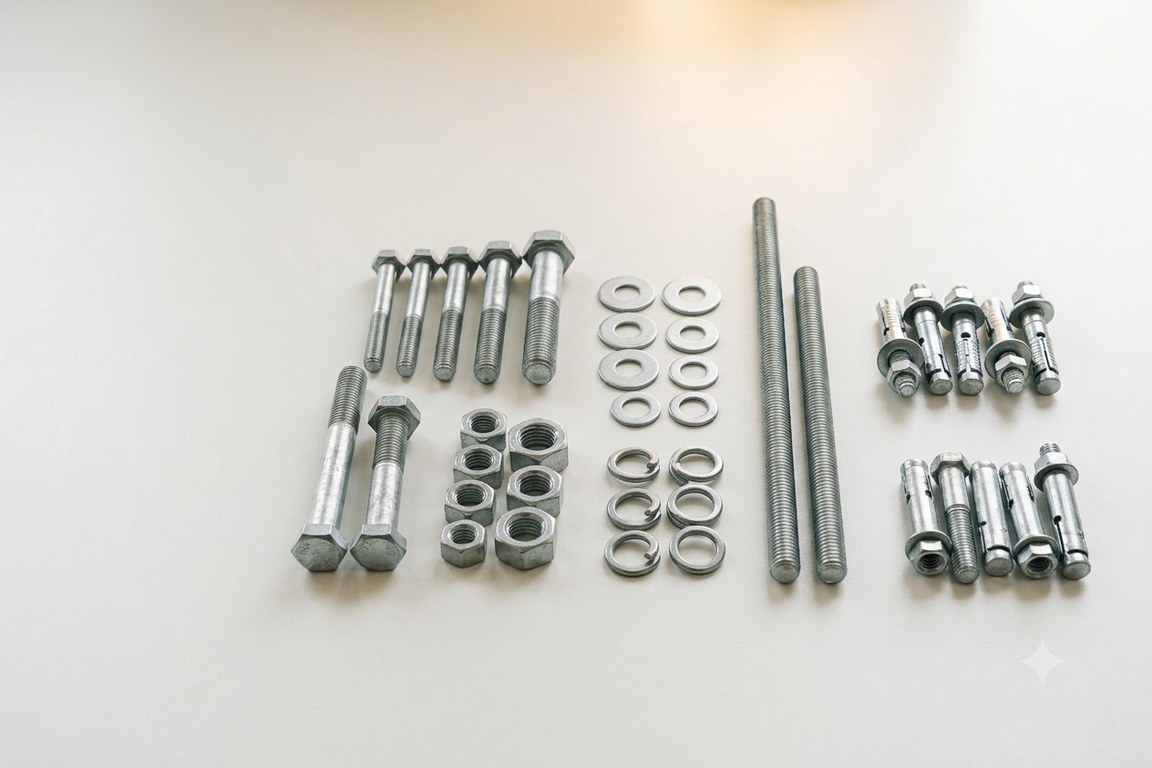
Hex bolts, set screws, machine screws and self-tapping screws. Diameter, length, thread form and the declared property class define the item — not the word “bolt” on an invoice.
Hex nuts, lock nuts, plain and spring washers. Low-value, high-volume items that still carry their own classification and their own declared grade.
Continuously threaded bar supplied in lengths or cut to size. The steel grade and the thread specification carry the declaration.
Expansion anchors set into masonry or concrete. Their function is anchorage performance in a base material, which is a different question from the strength of a screw.
Internally threaded anchors set flush into concrete and used with bolts or threaded rod. Assessed on the anchorage, the base material and the installed condition.
Fixings supplied for a load-bearing function in a structure. These are the items least likely to follow the same route as an ordinary nut or washer.
Thread, product design, material and whether the item forms part of a structural assembly all feed into the code.
Fasteners classify separately from one another far more often than a packing list suggests. A hex bolt, a plain washer, a length of threaded rod and an expansion anchor can each sit under a different heading, decided by the thread, the design, the material and whether the item is supplied as part of a structural assembly.
For that reason no single code is published here for the group. The code is confirmed per item from the product as it will actually be invoiced — see our HS code check. Send a product photo and the proposed code and we will review it against what you are shipping.
Screened against the actual product use, not against the category name.
Some fasteners and anchoring products fall within the scope of Saudi building-material requirements, where the product is demonstrably within that scope. Others do not. It is not correct to say every fastener sits under the same building-material regulation, or that the whole category follows one conformity scheme.
| Product subtype | Intended use | Technical information to review | Regulation / route |
|---|---|---|---|
| Bolts, screws, nuts, washers | General assembly and fixing | Material, property class, thread, finish, marking | Confirmed from the Saudi HS code and declared use |
| Threaded rod | Hanging, suspension, general fixing | Steel grade, thread specification, length, coating | Confirmed from the Saudi HS code and declared use |
| Sleeve and drop-in anchors | Anchorage into concrete or masonry | Base material, embedment, load data, installation instructions | Confirmed from the Saudi HS code and declared use |
| Structural fixings and beam clamps | Load-bearing connection in a structure | Load rating, design basis, material, protective coating | Confirmed from the Saudi HS code and declared use |
| Stainless and non-ferrous fasteners | Corrosive or exposed environments | Alloy designation, corrosion performance, mechanical data | Confirmed from the Saudi HS code and declared use |
Confirm the scope first
Whether a particular fastener or anchor falls inside an applicable technical regulation is a classification question, settled from the Saudi HS code and the declared use against the rules in force. It is confirmed before a route is chosen rather than assumed from the product name.
What to send, and what each item does for the assessment.
| Information | Why it may matter |
|---|---|
| Product photos and a dimensional drawing | Identify the exact form and construction of the item |
| Material, grade, finish and coating | Check the claimed specification against the evidence |
| Diameter, length, thread and load rating | Define the model or the product family being declared |
| Manufacturer and country of origin | Confirm the producing factory and the source of the goods |
| Material or mechanical test reports already held | Support the assessment where the route calls for evidence |
| Marking and packaging artwork | Compare the product identity and labels with the declaration |
Depending on the application, the evidence may cover material composition, mechanical strength, coating performance, dimensional tolerance and anchorage performance. Which of those are actually tested depends on the applicable standard and the intended use — they are not a fixed list applied to every fastener.
Send the product types, grades and the proposed Saudi HS codes. We will review which lines fall inside an applicable regulation before you commit to a shipment date.
Five steps, from classification to shipment documentation.
A screw, a threaded rod, an expansion anchor and a beam clamp are different products. Each classification is confirmed before any requirement is assumed.
Screen the declared use against the technical regulations in force, and establish which route the certification body applies to the item as presented.
Check the model list, the declared property classes and the test evidence already held against what the route calls for.
Where the applicable scheme calls for independent testing or a factory assessment, it is scheduled at this point rather than after shipment is booked.
Submit for assessment by the approved certification body, then raise each consignment against the certification in place with the Saudi importer.
The question that decides how many certificates a fastener catalogue needs.
A fastener range is rarely one product. A single diameter can run across a dozen lengths, two finishes and three property classes, and the commercial instinct is to treat the whole table as one item.
Grouping sizes or models together is possible in some cases, where the relevant certification rules allow it and the technical evidence supports the range claimed. What is not safe is the assumption: one certificate across every fastener, every grade and every HS heading is not something that can be promised in advance. The scope is approved by the certification body — see how PCoC model scope is assessed.
Driven by the number of distinct classifications, not by the number of cartons.
The SABER platform fee, the certification body’s assessment, any laboratory testing, a factory assessment where the scheme calls for one and professional assistance are charged separately. On fasteners, what usually moves the figure is how many separate classifications the catalogue breaks into once it is screened properly.
We quote per file rather than publishing a fastener certification price, and we do not give guaranteed completion dates. See SABER certificate cost for how a quotation is itemized.
Six recurring problems in fastener and anchor files.
Bolts, nuts, washers, rod and anchors declared under a single code. They can carry different classifications and, with them, different routes.
Without the diameter, length, grade and finish there is nothing for the assessment to match the evidence against.
A property class on the datasheet that the mechanical results do not reach is one of the clearest ways a fastener file is queried.
An expansion or drop-in anchor performs in a base material. Describing it as a screw skips the specification that actually defines it.
The producing factory on the test report, the manufacturer on the application and the supplier on the invoice should reconcile.
Grouping sizes under one certificate is possible in some cases, but it depends on the approved scope — not on the sizes sharing a carton.
The parent construction category, the classification check, and the certificates a fastener file is assessed toward.
PCoC obligations, grouping bolts with nuts, mill certificates, anchors, factory inspection and starting without an HS code.
Not automatically. Whether a fastener needs a SABER product certificate depends on its Saudi HS code and the technical regulation that code falls under. Confirm the classification and the requirements currently in force before assuming the product is regulated — and before assuming it is not.
Only where the approved scheme and the certificate scope permit it. Bolts and nuts can classify separately, and a grouping the certification body has not approved is not a grouping you can ship against.
Not necessarily. An MTC records the cast analysis and the mechanical results for the material supplied, which is useful evidence. Whether it satisfies the route, or whether independent testing is also required, is decided by the approved certification body against the applicable regulation.
They may be. An anchor is specified by how it performs in a base material, with embedment and load data behind it; a screw is specified by its thread, dimensions and property class. A different product function can mean a different classification and a different evidence set.
Only where the applicable scheme requires it. It is not a general obligation across the category, and it is settled at classification rather than assumed from the product type. See our factory inspection page for how a visit is arranged.
Yes. Send photographs, dimensions, the declared grade and the manufacturer details, and we will review the likely classification with you. The code still has to be confirmed before a route is fixed, but it is not needed to start.
Share the product type, dimensions, material grade, manufacturer information and photos. We will review the proposed Saudi classification and outline the applicable next steps.
Tell us the fastening type, material, grade, sizes and intended application. We reply within one business day with the likely route and what to send next.