Submersible pumps
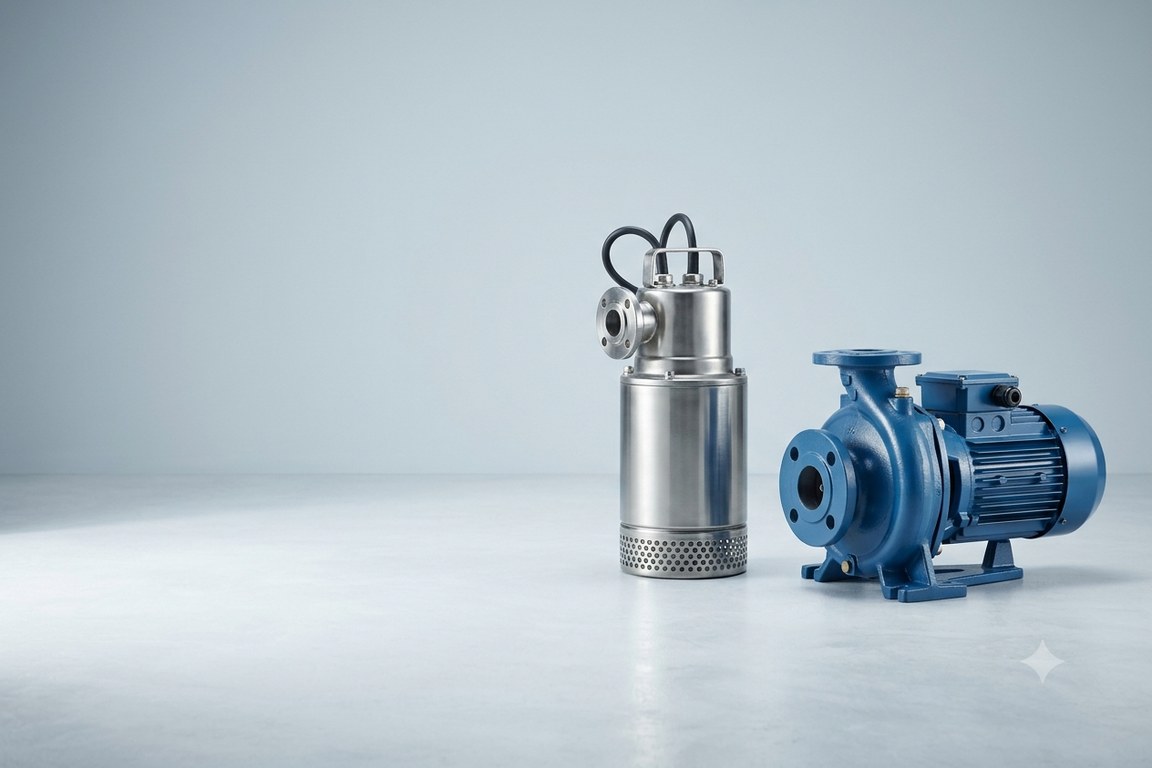
Installed below the liquid level, so the motor enclosure, cable entry and ingress protection are part of what defines the product.
Exporting submersible, centrifugal, sewage or dewatering pumps to Saudi Arabia? BenzilaCert helps assess product classification, electrical and mechanical specifications, technical documents, relevant conformity requirements and shipment certification.
Send to scope a pump file:
The duty a pump is built for is part of what defines it — power rating alone does not separate these products.
Installed below the liquid level, so the motor enclosure, cable entry and ingress protection are part of what defines the product.
End-suction and in-line units driven by a coupled motor. Rated flow and head, and the motor mounted to them, carry the declaration.
Built to pass solids, usually with a cutter or vortex impeller. The duty, not just the power rating, is what distinguishes them.
Portable site units for construction and drainage work, frequently supplied with a trolley, hose kit or integral control.
Pressure sets for building water supply, often sold as a skid with a pressure vessel, sensors and a control panel included.
Chemical, dosing and transfer duties where the handled medium, the seal arrangement and the material of construction drive the specification.
A complete pump and a separately supplied control panel can classify differently.
Classification follows the pump type, how it operates, how it is constructed and what is actually declared. A complete pump and an independently supplied electrical control panel or accessory may sit under different codes, with different requirements behind them.
No single code is published here for the category. To review it properly we ask for the product drawings, the datasheet, the nameplate photographs and an itemized invoice — see our HS code check.
Screened from the product specification, not applied across the category.
A pump can bring more than one requirement into play. Depending on the specification there may be machinery-safety, electrical or water-related requirements to screen, and a motor-driven unit is read differently from a bare pump end.
What this page will not do is state that every pump needs an IECEE certificate, a Saudi Quality Mark, a MIM declaration or a factory inspection. Each of those applies where the scheme and the product bring it in, and that is established at the assessment stage — see regulatory assessment.
One pump, more than one possible route
Where a pump is supplied with its own starter, panel or integrated control, the electrical assembly may carry requirements of its own alongside the pump. Both are screened before the route is fixed.
Eight items that let an assessment start without a second round of questions.
| Information | Example of what to request |
|---|---|
| Pump type and application | Sewage, water supply, dewatering or process duty |
| Flow rate and head | Rated performance data from the pump curve |
| Power and motor rating | kW or HP, phase, frequency and voltage |
| Model list | The full model or series list to be covered |
| Manufacturer and country | Factory name, address and country of origin |
| Materials and protection | Casing and impeller material, and IP rating as applicable |
| Existing reports | Safety, mechanical or other reports already held |
| Invoice accessories | Controller, coupling, guide rails, brackets and similar items |
The product stage, then the shipment stage.
At the shipment stage the commercial invoice and packing list are reconciled against the certification in place, together with the valid product certificate or declaration record the consignment is raised against. See the SABER documents checklist for the full lists.
Send the itemized invoice along with the pump datasheet. We will review which accessories sit inside the product scope and which need their own assessment.
The question that decides whether a pump consignment clears cleanly.
A single shipment often contains a complete pump plus a base coupling, a duck-foot base, guide rails, a bracket, a control panel or other installation items. The usual assumption is that everything in the crate is covered by the pump’s certificate.
That assumption is the one worth checking. An accessory invoiced separately is not automatically inside the pump’s PCoC. Each item is reviewed for what it actually is: physically part of the approved product, a separately traded item, or a product requiring its own classification and assessment. Where the position is unclear, the approved certification body and the Saudi importer confirm it before the goods move.
Five steps, from classification to shipment documentation.
Collect the pump details, the accessory list and the proposed Saudi HS codes — including separate codes for anything invoiced on its own line.
Screen the specification against the Saudi requirements in force for that product, rather than applying a single machinery rule across the category.
Check the datasheet, nameplate, motor data and existing reports against the scope the route calls for.
Where additional testing or assessment applies, arrange it, then submit for the product certificate through the approved certification body.
Reconcile the certified models and accessories against the commercial invoice, then coordinate the shipment certificate with the Saudi importer.
Driven by the model count and whether the electrical assembly needs its own file.
The SABER platform fee, the certification body’s assessment, any laboratory testing, a factory assessment where the scheme calls for one and professional assistance are charged separately. On pumps, the figure usually moves with how many models the series breaks into and whether a panel or starter needs a file of its own.
We quote per file rather than publishing a pump certification price, and we do not give guaranteed completion dates. See SABER certificate cost for how a quotation is itemized.
Six recurring issues in pump files.
A sewage pump entered as a general water pump, or a booster set as a single pump. The subtype is part of what decides the requirement.
Flow, head, power, phase and voltage missing from the submission, so there is nothing to match the test evidence against.
Models shipped that never appeared on the application, usually variants added after the certificate was applied for.
The panel arrives on its own invoice line and is assumed to be inside the pump certificate. That assumption is checked, not made.
Guide rails, base elbows, brackets and chains added to the carton late, after the scope was already agreed.
A report issued against a superseded model, or an importer on the application who is not the importer of record on the shipment.
The parent machinery category, the classification check, and the certificates a pump file is assessed toward.
Whether one route fits every pump, control panels, model grouping, factory inspection, installation kits and what a quote needs.
No. Classification and requirements vary with the pump type, the construction, the motor and the declared application. A submersible sewage pump, a booster set and a chemical dosing pump are not one product for certification purposes, even where they share a catalogue.
Do not assume so. Where the panel is supplied and invoiced as a separate article it may carry its own classification and its own assessment. The scope has to be reviewed with the certification body rather than inferred from the fact that the two ship together.
Potentially, subject to the assessment and the approved model scope. Where models share a platform and the evidence supports the range, grouping is often possible; markedly different constructions or ratings generally mean separate evidence.
Only where the applicable scheme requires it. It is not a general obligation for the category. Where it does apply it needs scheduling early, because it sits on the critical path — see our factory inspection page.
Each item is checked, along with how it appears on the invoice. A duck-foot base, guide rails, a bracket or a chain may be part of the approved product, a separately traded item, or something requiring its own classification. The approved certification body and the importer confirm the position where it is unclear.
The pump type, the rated specifications, the model list, the manufacturer, the Saudi HS code if you have it, and any supporting reports already held. With those we can outline the likely route before quoting.
Send the pump type, power, voltage, phase, application, the accessories included, the manufacturer and the model count. We will review the likely route and what evidence is missing.
Tell us the pump type, the rated specifications, the accessories included and the model count. We reply within one business day with the likely route and what to send next.