Plugs and rewireable plug tops
Fitted and rewireable plugs. The pin pattern, the fuse arrangement where fitted and the cord anchorage carry the assessment.
Exporting plugs, socket outlets or extension leads to Saudi Arabia? BenzilaCert helps manufacturers and exporters check the pin configuration against what the market accepts, confirm which part of the accessory regulation applies, and prepare the testing and model list for SABER certification.
Send to scope an accessory file:
This is the one electrical category where a fully tested, fully compliant product can still be unsuitable for the market.
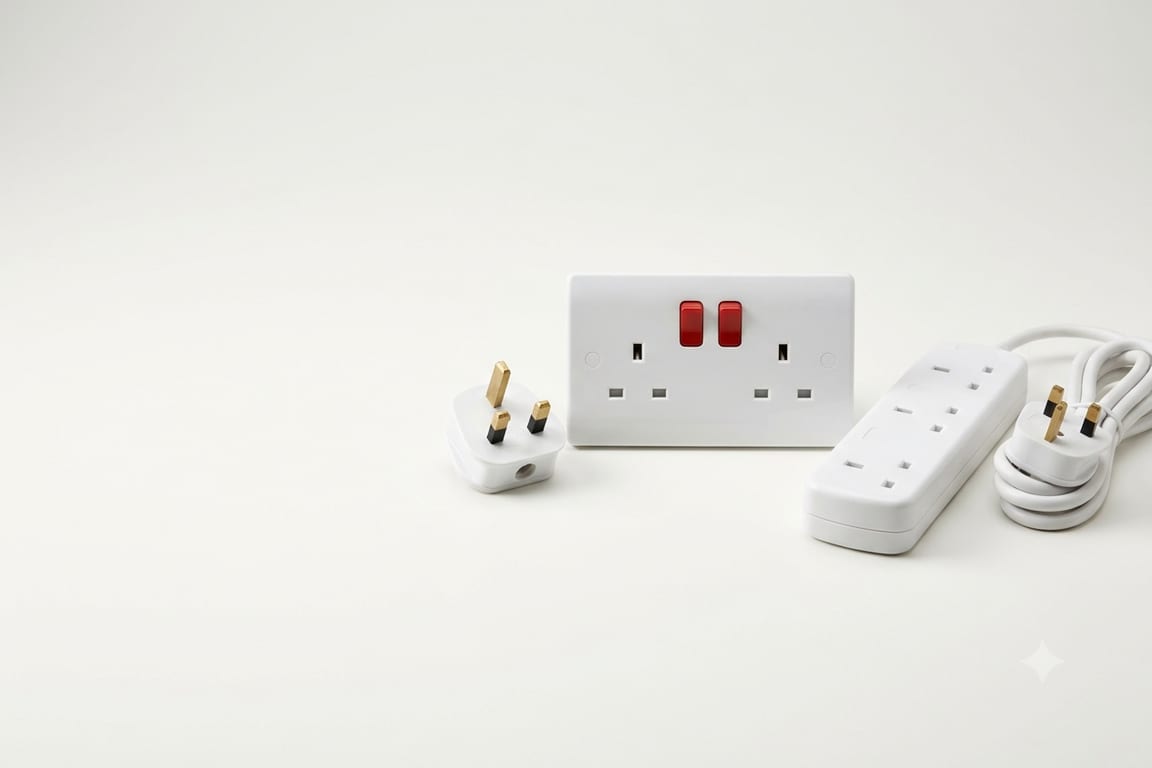
The Type G configuration — the three rectangular-pin BS 1363 pattern — is the prevailing domestic plug and socket configuration in Saudi Arabia, and products intended for general domestic use are expected to match it. A plug or outlet built to another country's pattern can hold complete and valid test reports and still not be suitable, because the configuration is a separate question from electrical safety.
That is why configuration is checked before anything else on this category. No test programme resolves a non-conforming pin pattern. Which configurations are permitted for a specific product type is confirmed from the current applicable regulation rather than assumed, because industrial couplers and certain appliance inlets follow different patterns from the domestic outlet.
Declare the configuration per model
Fixed accessories, corded assemblies and adaptors are assessed differently, so the range is separated first.
Fitted and rewireable plugs. The pin pattern, the fuse arrangement where fitted and the cord anchorage carry the assessment.
Flush and surface outlets, switched and unswitched, including those with integral USB or charging circuits.
Corded multi-way units. Assessed as a complete assembly, so the plug, the cord and the outlets are one product.
Units that change one configuration to another. The most scrutinised subtype, because the conversion itself can be the problem.
Higher-rated industrial couplers and interlocked sockets, assessed against a different part of the accessory family.
Outlets declared for outdoor or wet locations, where the ingress protection rating forms part of the evidence.
Six factors that separate one accessory file from another, read from the product rather than from the category name.
| Factor | Why it changes the answer |
|---|---|
| Pin configuration | The physical pin pattern is the first filter for this category, before any test evidence is considered |
| Fixed accessory or corded assembly | A wall outlet and a trailing extension lead are different products with different evidence |
| Rated voltage and current | Declared ratings define the model family and constrain how variants can be grouped |
| Integral fuse or protective function | A fuse, RCD or surge function inside the accessory brings that function into the assessment |
| Integral electronics | USB or charging circuits inside an outlet add a power supply to what is otherwise a passive accessory |
| Household or industrial use | The declared intended use points at a different part of the plugs and sockets family |
We do not publish an HS code for plugs and sockets, because the code follows the product specification rather than the category. Plugs, fixed outlets, corded assemblies and parts can classify differently, and the classification is what determines the applicable regulation. It is confirmed per family — see our HS code check.
What may apply to an accessory file, and what is confirmed per product type.
Where the confirmed classification falls under an applicable Saudi technical regulation, a plug, socket or extension assembly generally needs a product certificate registered on SABER, followed by a shipment certificate for each consignment. The product certificate is issued by an approved conformity assessment body against the technical file and the test evidence.
Within the accessory family, the declared intended use points at different parts of the regulation: household accessories, industrial couplers and extension assemblies are not all assessed the same way. Where an outlet contains an integral USB or charging circuit, that circuit is assessed in addition to the accessory function, because the product then contains a power supply as well.
Marking is assessed as part of the file rather than left to the packaging stage. See Saudi product label review for how marking and artwork are checked before shipment.
Checks an accessory assessment commonly draws on. Which apply depends on the product type and the standard edition the regulation names.
| Check | What it looks at |
|---|---|
| Dimensional conformity | Pin and contact dimensions against the declared configuration |
| Protection against electric shock | Access to live parts, shutters and pin insulation where required |
| Temperature rise | Contacts and terminals at declared rated current |
| Insulation resistance and dielectric strength | Insulation under applied test voltage |
| Mechanical strength | Cord anchorage, pin retention and resistance to impact |
| Making and breaking capacity | Repeated insertion and withdrawal under load |
| Resistance to heat and fire | Behaviour of the enclosure material under heat and glow-wire conditions |
| Ingress protection (IP) | Dust and water protection — where an outdoor or wet-location claim is declared |
Testing is carried out by laboratories accredited for the relevant tests. Dimensional conformity sits at the top of the list deliberately: it is the check that decides whether the rest of the programme is worth running.
What an accessory submission is built from. The per-model configuration declaration is the part most often missing.
Send the model list with pin configurations, ratings and any test reports you hold. We will check the configuration question before anything else, so you are not funding testing on products that cannot be used.
Five steps, starting with the configuration check rather than the paperwork.
Each model is checked against the configuration acceptable for its product type in Saudi Arabia, because a non-conforming pattern cannot be resolved by test evidence.
Confirm the Saudi HS code per family, then the applicable technical regulation and which part of the plugs and sockets family is named for each product type.
Check what existing reports cover against the declared configurations, ratings and integral functions, and identify the remaining testing.
Prepare the technical file and the model list, then submit for assessment by the approved certification body.
Each consignment is applied for against the product certificate, with the invoice models matching the certified list exactly.
Separate the government fees from the body, testing and service charges before comparing quotations.
Four things move the cost of an accessory programme: how many configurations and product types the range splits into, how much of the required testing the existing reports already cover, whether integral charging circuits or outdoor claims bring additional checks, and the number of consignments needing shipment certificates.
Government and SADAD fees, conformity body charges, laboratory testing and service charges are separate lines and are quoted separately. Our SABER certificate cost page sets out how those lines work. We do not publish a flat price or a guaranteed turnaround for an accessory file, because both depend on the range split and the testing gap.
Six issues we see repeatedly on plug, socket and extension submissions.
The failure unique to this category. A plug or outlet built to another country’s pattern can be fully tested and still be unsuitable, and no amount of test evidence fixes it.
Catalogues often group configurations together by rating. For Saudi Arabia the configuration has to be declared and assessed per model, not averaged across the family.
A trailing socket is one product: plug, cord and outlets together. Submitting certificates for the parts does not certify the assembly.
A USB outlet contains a power supply. Leaving that circuit out of the declaration is found when the product is examined rather than at submission.
Where the design relies on an integral fuse, the fuse rating and its evidence form part of the file. A plug declared with a fuse but tested without one does not match.
Rating and configuration marking on the product body is read against the technical file. Differences surface at review.
The wider electrical category, marking review, and the certificates an accessory family ends up on.
Saudi socket type, whether test reports are enough, extension assemblies, USB outlets, grouping and the shipment stage.
The Type G configuration — the three rectangular-pin BS 1363 pattern — is the prevailing domestic socket and plug configuration in Saudi Arabia, and products intended for general domestic use are expected to match it. Which configurations are permitted for a specific product type is confirmed from the current applicable regulation rather than assumed, because industrial couplers and some appliance inlets follow different patterns.
Where the confirmed Saudi HS code for the accessory falls under an applicable technical regulation, it generally needs a product certificate registered on SABER and then a shipment certificate per consignment. It is decided by the classification of the product rather than by the category name.
Not on its own. This is the one electrical category where a product can hold complete and valid test reports and still be unsuitable, because the pin configuration is a separate question from electrical safety. The configuration is checked first, since no test evidence resolves a non-conforming pattern.
Generally yes. A corded extension or trailing socket is assessed as a complete assembly, so the plug, the flexible cord and the outlets are evaluated together. Certificates for the individual parts support the file but do not replace an assembly submission.
A socket with an integral USB or charging circuit contains a power supply as well as an accessory, so that circuit is assessed in addition to the socket function. It is declared at the start rather than treated as a feature of the housing.
Variants within one configuration that share construction and standards can often be grouped, subject to the certification body accepting it. A family that spans several national pin patterns is normally separated, because the configuration is declared per model.
The commercial invoice and packing list with model numbers exactly as certified, the product certificate reference, and the transport and origin documents as they become available. Our SABER documents checklist sets out the full list.
Send the model list with pin configurations and ratings, plus any test reports you hold. We will confirm whether the products suit the market, then what evidence is missing.
Tell us about the plugs, sockets or extension leads you ship, their pin configurations and ratings. We reply within one business day with the likely route and what to send next.