Complete elevator systems
Passenger, freight and service elevators supplied as a full system. The safety components, the controller, the drive and the car are assessed as an integrated product.
Exporting elevators or elevator spare parts to Saudi Arabia? BenzilaCert helps review the part function, distinguish spare components from complete systems, and confirm the applicable SABER certification requirements for each item.
Send to scope an elevator parts file:
A complete elevator, a controller, a COP and a travelling cable are not the same product for certification.
Passenger, freight and service elevators supplied as a full system. The safety components, the controller, the drive and the car are assessed as an integrated product.
Main controller boards, inverter drives and integrated control cabinets. These may carry electrical safety and EMC requirements separate from the elevator safety regulation.
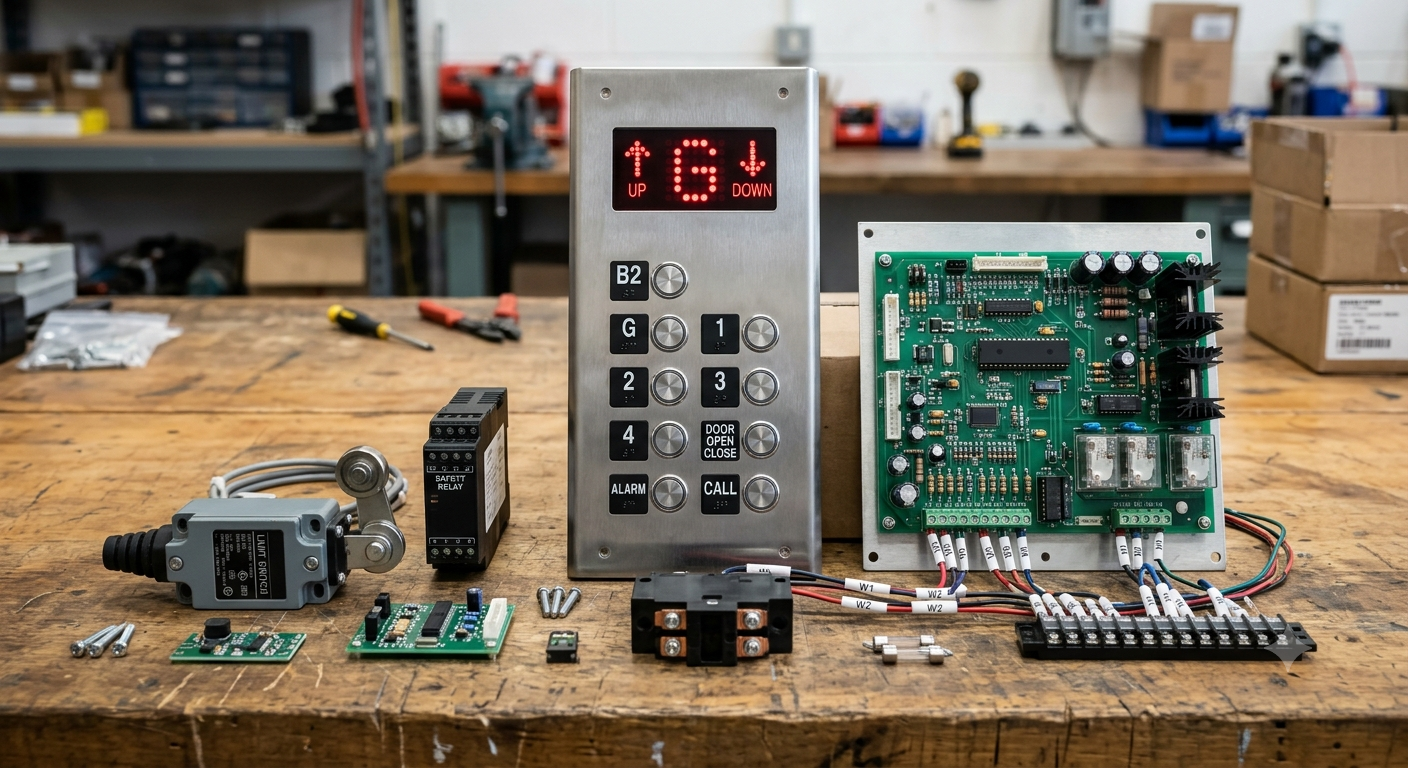
User interface panels with push buttons, displays and indicators. The function, the voltage and the construction determine how they are classified.
Battery-powered units that return the car to a landing during a power failure. A safety function that may need its own assessment.
Speed governors, safety gears, buffers and door locks — the components that the elevator safety regulation specifically names.
Pre-assembled wiring harnesses and travelling cables supplied as elevator spare parts. Classification depends on whether they are traded as cables or as part of an elevator system.
Elevator safety, electrical safety and EMC may all be relevant — depending on the part.
Complete elevator systems fall under the applicable elevator safety regulation. Spare parts, however, may fall under elevator safety, electrical safety, EMC or a combination — depending on the part function and how it is traded.
A controller with active electrical components is not treated the same way as a mechanical guide shoe. See machinery certification for the parent industrial equipment scope and electrical appliances certification for where electrical requirements apply.
The distinction that shapes most elevator parts files.
A COP, a controller, an ARD and a wiring kit are each products in their own right when they are traded as spare parts. They are not automatically inside a complete elevator certificate, and they may each classify under a different HS heading.
Safety components — speed governors, safety gears, buffers and door locks — are specifically named in the elevator safety regulation and may carry their own assessment.
Check the HS code per part
Grouping all spare parts under one HS heading is the most common error. A controller, a COP and a travelling cable can fall under different headings with different requirements.
A preliminary list — the final evidence set depends on the part function and the applicable regulation.
Existing type examination certificates from internationally recognized bodies may support the Saudi assessment. Whether they are accepted depends on the scope, the currency of the evidence and the approved certification body. See technical documentation review for how evidence is checked.
Send the part type, function and model list. We will confirm the classification and the applicable requirements.
Five steps, from part identification to shipment documentation.
Separate complete systems from spare parts, and within spare parts, distinguish safety components from general electrical and mechanical items.
A controller, a COP and a travelling cable may classify under different headings and fall under different requirements.
Check existing type examination certificates, test reports and declarations against the part as supplied and the applicable Saudi requirements.
Prepare the technical file and coordinate with the approved certification body for the product certificate.
Reconcile the certified parts and ratings against the commercial invoice, then coordinate the shipment certificate with the Saudi importer.
Driven by the number of distinct part types and how many separate classifications they carry.
The total depends on the SABER platform charges, the certification body’s review, any additional testing, and the agreed professional support. An invoice with several distinct part types classifying under different headings is usually more than a single product file.
We quote per file and do not give guaranteed completion dates. See SABER certificate cost for how a quotation is itemized.
Six recurring issues in elevator spare part files.
A controller, a COP, an ARD and a wiring kit on one invoice under a single heading. They can fall under different regulations and different routes.
A controller or drive unit treated only under the elevator safety regulation, when it also carries electrical safety and EMC requirements of its own.
An existing certificate covers a previous hardware revision, but the model being shipped is the current one. Version traceability is checked.
A speed governor or a safety gear entered as a general mechanical part, missing the safety-component assessment it carries.
The factory on the type examination, the manufacturer on the application and the supplier on the invoice must reconcile.
A report or certificate issued against an older design, where the current production has changed materials, firmware or component sources.
The parent machinery category, the electrical and classification schemes, and the certificates elevator parts are assessed toward.
COP vs controller, model grouping, type examinations, safety components, factory inspection and what a quote needs.
Where the Saudi HS code falls under an applicable regulation, the part generally needs certification registered on SABER and a shipment certificate per consignment. The position depends on the part function and its classification.
Not necessarily. A car operating panel and a main controller serve different functions and may fall under different requirements. Each is checked separately.
Where models share the same construction and the evidence supports the range, grouping is often possible. Parts with different functions or significantly different ratings generally need separate evidence.
They may support the assessment where they cover the applicable standard and the product as currently supplied. Whether they are accepted in full depends on the certification body and the currency of the evidence.
Not automatically. Some parts — particularly electrical sub-assemblies — may fall under electrical safety or EMC requirements in addition to or instead of the elevator safety regulation.
Only where the applicable scheme requires it. It is settled at classification, not assumed from the product category.
The part type and function, the model and rating list, the manufacturer, the Saudi HS code if you have it, and any existing type examination certificates or test reports.
Send the part types, functions, model and rating lists and any existing type examination certificates. We will confirm the classification and what evidence is needed.
Tell us the part types, their functions, the model list and any existing certificates. We reply within one business day with the likely route and what to send next.